
Molecule T-shirts · indole alkaloid
Ibogaine T-Shirt
A complex indole alkaloid from the root bark of a West African shrub, now the subject of state-funded clinical trials.
Printed to order on a Bella+Canvas 3001 unisex tee. Sizes, colours and the price per option are on the listing.
Printed to order, ships in 2–5 business daysReplaced free if it arrives damagedEtsy buyer protection
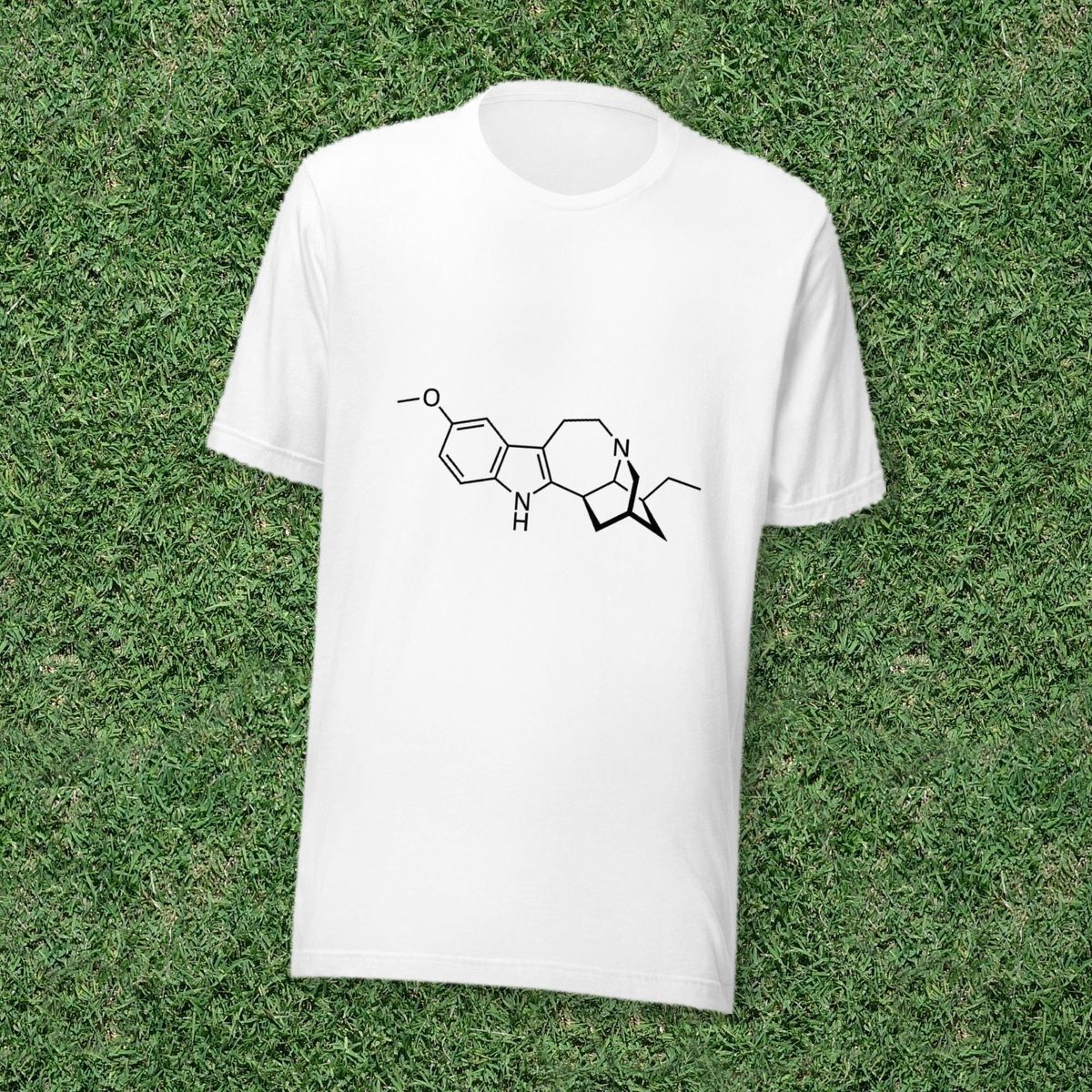
What is printed. This shirt carries the skeletal structure of ibogaine drawn as a standard line diagram, with the name and the formula C20H26N2O set beneath it. Ibogaine is an indole alkaloid found mainly in the root bark of Tabernanthe iboga, a shrub of Gabon and neighboring countries, and in smaller amounts in Voacanga africana. The structure is one of the more intricate in the molecule series: an indole ring fused to a seven-membered ring and a rigid isoquinuclidine cage, with a methoxy group on the aromatic ring and an ethyl side chain. Chemistry has known the compound since 1901, the Bwiti religion of Gabon for far longer. It is controlled in many countries and carries a documented cardiac risk.
History
French colonial scientists described the iboga plant in the 1880s. The alkaloid was isolated from the root bark in 1901 by Jan Dybowski and Edouard Landrin in Paris, and independently that year by Albert Haller and Edouard Heckel, who named it. Its full structure was settled in 1957, and George Buchi's group at MIT reported the first total synthesis in 1966. From 1939 a low-dose ibogaine preparation called Lambarene was sold in France as a tonic and antidepressant; it was withdrawn in the 1960s. In 1962 Howard Lotsof, a 19-year-old New Yorker, observed that ibogaine appeared to interrupt opioid dependence in himself and several acquaintances; he promoted its study for the rest of his life and received a US patent for the use in 1985. The United States placed ibogaine in Schedule I in 1970. The FDA approved a Phase I safety trial at the University of Miami in 1993; it was never completed. In January 2024, Cherian and colleagues at Stanford University published in Nature Medicine an observational study of magnesium-ibogaine treatment in 30 male special operations veterans with traumatic brain injury, reporting improvements in disability, PTSD, depression and anxiety at one month and no serious adverse events; there was no control group. On June 11, 2025, Texas Governor Greg Abbott signed Senate Bill 2308, committing 50 million dollars of state funds to a public-private consortium to carry ibogaine through FDA clinical trials.
What ibogaine does
Ibogaine is not a classical psychedelic. It acts on several targets at once: it blocks NMDA glutamate receptors, activates kappa opioid receptors, inhibits the serotonin transporter and blocks nicotinic acetylcholine receptors, and its long-lived metabolite noribogaine shares several of these actions. It also blocks the hERG potassium channel in heart muscle, which prolongs the QT interval of the electrocardiogram and has been linked to fatal arrhythmias; this cardiac risk is the main safety concern in every clinical protocol, and the Stanford study administered magnesium specifically to address it. Ibogaine occurs in Tabernanthe iboga root bark and in Voacanga africana. It is Schedule I in the United States, unscheduled in some countries, and available by prescription in New Zealand. Research centers on substance use disorders and, since 2024, on traumatic brain injury; no ibogaine medicine is approved anywhere.
Who wears it
Veterans and veterans' advocates who followed the Stanford study and the Texas legislation, which was championed by former Governor Rick Perry. People in recovery from opioid dependence and their families, for whom the molecule has symbolic weight whatever its eventual clinical verdict. Pharmacology students who appreciate a compound that hits NMDA, kappa opioid, serotonin and nicotinic targets at once, and chemists who admire the 1966 Buchi synthesis of its pentacyclic cage. Anthropologists and anyone interested in Gabon and the Bwiti tradition. It reads as a serious shirt: a molecule with a 125-year history in chemistry, a documented cardiac risk, and a 50 million dollar state research program.
Facts
- Ibogaine was isolated in 1901, but its full chemical structure was not determined until 1957, and the first total synthesis came in 1966.
- The Stanford MISTIC study published in Nature Medicine in January 2024 enrolled 30 special operations veterans and reported no serious adverse events, but it was uncontrolled.
- Texas Senate Bill 2308, signed June 11, 2025, is the largest state-funded psychedelic research program in US history at 50 million dollars.
- Ibogaine blocks the hERG potassium channel, which prolongs the QT interval and is the mechanism behind the deaths associated with its use outside medical settings.
- The Bwiti religion of Gabon uses the iboga root in initiation ceremonies, and Gabon declared the plant a national treasure in 2000.
The same molecule as a print
Frequently asked questions
- Is the structure on the shirt chemically accurate?
- Yes. It is the standard skeletal formula of ibogaine as recorded in PubChem (CID 197060): the indole system fused to the seven-membered ring and the isoquinuclidine cage, with the methoxy group on the aromatic ring and the ethyl side chain. Ibogaine has four stereocenters, and the natural (-)-enantiomer is shown with wedge and hashed bonds in the usual way.
- What exactly is printed, and in which colors?
- The skeletal structure of ibogaine, with the name and the molecular formula set beneath it in letter-spaced type. The design is printed as a single color on the chest of a unisex tee: white ink on a black shirt or black ink on a white shirt. The print area is the standard chest placement, about 10 to 12 inches wide depending on shirt size. The structure is drawn from PubChem compound data; the composition and typography are ThinkDotCo's own work.
- Is it legal to wear?
- Yes. The shirt carries a chemistry diagram, the same line drawing you would find in a textbook, an encyclopedia, or a government chemical database. A picture of a molecule is not the molecule. Wearing it is legal anywhere, including places where the compound itself is controlled. The shirt contains no substance of any kind and makes no claim about use.
- Is ibogaine an approved medicine?
- No. As of 2025 no regulator has approved an ibogaine product. It is Schedule I in the United States, available by prescription in New Zealand, and unregulated in some other countries. The Stanford Nature Medicine study of 2024 was observational and had no control group, and the Texas program signed into law in June 2025 exists precisely to fund the controlled trials that have never been run. The compound's known effect on the heart's QT interval is the central reason those trials are needed.
Related molecule t-shirts
- Morphine t-shirt C17H19NO3
- DMT t-shirt C12H16N2
- Serotonin t-shirt C10H12N2O
Sources
- Ibogaine, Wikipedia
- PubChem compound summary, CID 197060
- Cherian K.N. et al. Magnesium-ibogaine therapy in veterans with traumatic brain injuries. Nature Medicine 30, 373-381 (2024)
- Texas Legislature Online, SB 2308 (89th Regular Session, 2025)
Published 25 Oct 2026; prices are the live Etsy prices as of 25 Oct 2026. The structure diagram is a fact of chemistry; this page's text is © ThinkDotCo and may be quoted with a link.