
Molecule T-shirts · tryptamine alkaloid
DMT T-Shirt
A small tryptamine, two methyl groups on a serotonin-like core, found in plants, animals and human tissue.
Printed to order on a Bella+Canvas 3001 unisex tee. Sizes, colours and the price per option are on the listing.
Printed to order, ships in 2–5 business daysReplaced free if it arrives damagedEtsy buyer protection
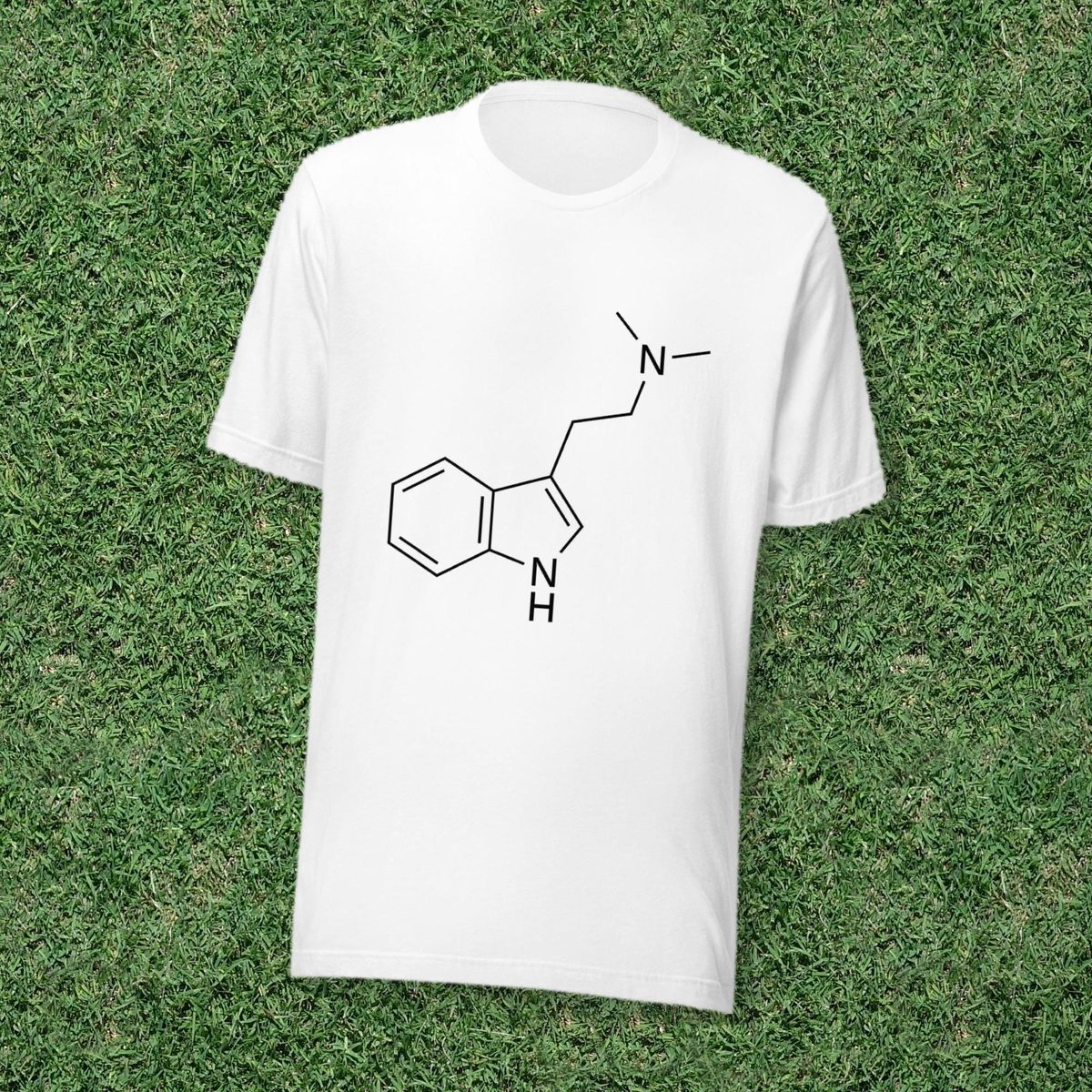
What is printed. This shirt carries the skeletal structure of N,N-dimethyltryptamine, DMT, drawn as a standard line diagram with its name and the formula C12H16N2 set beneath it. The molecule is one of the simplest of the tryptamines: an indole ring joined by a two-carbon chain to a nitrogen that bears two methyl groups. Serotonin, the neurotransmitter, shares the same indole and side chain, which is why the two structures look like close relatives when drawn side by side. DMT occurs naturally in dozens of plant species and has been detected in mammalian tissue, including human blood and brain, which makes it unusual among controlled compounds: the body makes trace amounts of it.
History
DMT was first made in a laboratory in 1931 by the chemist Richard Manske, working in Canada, as one of a series of tryptamine derivatives. In 1946 the Brazilian chemist Oswaldo Goncalves de Lima isolated an alkaloid he called nigerina from the root bark of Mimosa tenuiflora, the jurema tree; it was later shown to be DMT. In 1955 Fish, Johnson and Horning identified DMT in the seeds of Anadenanthera peregrina, the source of the cohoba snuff described by early Spanish chroniclers of the Caribbean. The compound's effects on the human mind were first described scientifically in 1956 by the Hungarian chemist and psychiatrist Stephen Szara in Budapest, who had been unable to obtain LSD from Sandoz and turned to DMT instead. In 1965 Franzen and Gross reported DMT in human blood and urine, the first evidence that the body produces it. DMT was placed in Schedule I of the United Nations Convention on Psychotropic Substances in 1971, and in Schedule I of the US Controlled Substances Act in 1970. Between 1990 and 1995 Rick Strassman at the University of New Mexico ran the first US government-approved human psychedelic study in two decades, with about 60 volunteers; his 2001 book DMT: The Spirit Molecule describes it. Since 2019, researchers at Imperial College London have published EEG and fMRI studies of the compound's effects on brain activity.
What dmt does
DMT acts mainly as an agonist at serotonin 5-HT2A receptors, the same receptor family targeted by LSD and psilocin; it also binds the sigma-1 receptor, a finding reported in Science in 2009. In the body it is broken down quickly by monoamine oxidase, which is why its action is brief and why the Amazonian preparation ayahuasca pairs DMT-bearing leaves of Psychotria viridis with the vine Banisteriopsis caapi, whose harmala alkaloids inhibit that enzyme. DMT occurs in many plant genera, including Mimosa, Acacia, Phalaris grasses and Anadenanthera, and in trace amounts in mammals. It is a Schedule I substance in the United States and under the 1971 UN Convention. Research on the compound is active in neuroscience, with academic imaging studies and early-stage clinical trials for depression under way in several countries; no DMT medicine is approved anywhere.
Who wears it
Neuroscience and pharmacology students who like that a molecule the body makes itself sits on a Schedule I list. Readers of Strassman's book and listeners to the podcasts it spawned. People following the Imperial College imaging work, or the ayahuasca churches whose right to use the brew was upheld by the US Supreme Court in 2006. Chemists and chemistry teachers who want a wearable example of a tryptamine next to a serotonin shirt. Also botanists and ethnobotanists: the molecule connects a Canadian lab bench in 1931 to Caribbean cohoba snuff, Brazilian jurema and Amazonian vine brews. It is a conversation piece for anyone interested in how the brain and plants share chemistry.
Facts
- DMT was first synthesized in 1931 by Richard Manske, 25 years before anyone knew it was psychoactive.
- DMT differs from serotonin by two methyl groups on the nitrogen and the absence of one hydroxyl group on the indole ring.
- The compound has been detected in human blood and urine since 1965 and is produced in trace amounts by mammals.
- Ayahuasca works because the harmala alkaloids in Banisteriopsis caapi block the enzyme that would otherwise destroy DMT in the gut.
- In Gonzales v. O Centro Espirita Beneficente Uniao do Vegetal (2006), the US Supreme Court ruled unanimously that a religious group could import its DMT-containing sacrament.
The same molecule as a print
- DMT Molecule (print), on Etsy from $29.99.
Frequently asked questions
- Is the structure on the shirt chemically accurate?
- Yes. It is the standard skeletal formula of N,N-dimethyltryptamine as recorded in PubChem (CID 6089): the indole bicycle with the ethylamine chain at the 3-position and two methyl groups on the terminal nitrogen. DMT has no stereocenters, so no wedge bonds are needed; the drawing uses the same conventions as a chemistry textbook.
- What exactly is printed, and in which colors?
- The skeletal structure of DMT, with the name and the molecular formula set beneath it in letter-spaced type. The design is printed as a single color on the chest of a unisex tee: white ink on a black shirt or black ink on a white shirt. The print area is the standard chest placement, about 10 to 12 inches wide depending on shirt size. The structure is drawn from PubChem compound data; the composition and typography are ThinkDotCo's own work.
- Is it legal to wear?
- Yes. The shirt carries a chemistry diagram, the same line drawing you would find in a textbook, an encyclopedia, or a government chemical database. A picture of a molecule is not the molecule. Wearing it is legal anywhere, including places where the compound itself is controlled. The shirt contains no substance of any kind and makes no claim about use.
- Why does DMT look so much like serotonin?
- Both are tryptamines built on an indole ring with a two-carbon chain ending in a nitrogen. Serotonin carries a hydroxyl group at the 5-position of the ring and a bare NH2; DMT lacks the hydroxyl and has two methyl groups on the nitrogen. That small difference changes how the molecule crosses membranes and which receptors it reaches, and it is the reason the two shirts are often bought as a pair.
Related molecule t-shirts
- Serotonin t-shirt C10H12N2O
- Psilocybin t-shirt C12H17N2O4P
- LSD t-shirt C20H25N3O
Sources
- N,N-Dimethyltryptamine, Wikipedia
- PubChem compound summary, CID 6089
- Szara S. Dimethyltryptamin: its metabolism in man. Experientia 12, 441-442 (1956)
- Fontanilla D. et al. The hallucinogen N,N-dimethyltryptamine (DMT) is an endogenous sigma-1 receptor regulator. Science 323, 934-937 (2009)
Published 25 Oct 2026; prices are the live Etsy prices as of 25 Oct 2026. The structure diagram is a fact of chemistry; this page's text is © ThinkDotCo and may be quoted with a link.