
Molecule T-shirts · opiate alkaloid
Morphine T-Shirt
The principal alkaloid of the opium poppy, the first alkaloid ever isolated, and still an essential medicine.
Printed to order on a Bella+Canvas 3001 unisex tee. Sizes, colours and the price per option are on the listing.
Printed to order, ships in 2–5 business daysReplaced free if it arrives damagedEtsy buyer protection
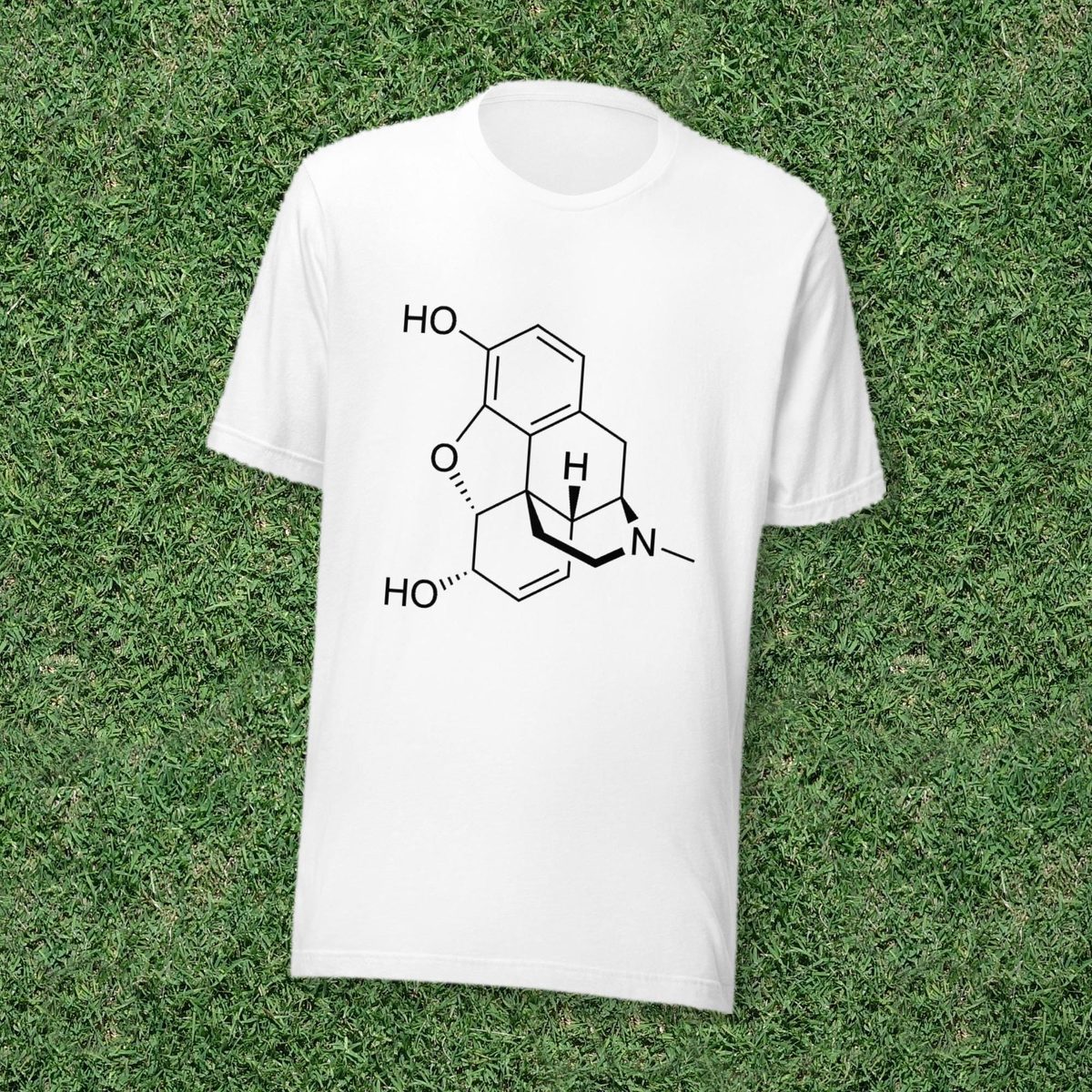
What is printed. Printed on the chest is the skeletal structure of morphine, C17H19NO3, drawn as a line diagram with its name and formula beneath. The drawing shows five fused rings: an aromatic ring carrying a phenol, a cyclohexene ring carrying a second hydroxyl, an ether bridge locking the two together, and a piperidine ring whose nitrogen carries a methyl group. Wedge and hash bonds mark its five stereocenters. Morphine is the main alkaloid of the opium poppy, Papaver somniferum, and the compound against which every other painkiller is still measured. The shirt shows the chemistry, nothing more.
History
Opium has been harvested from poppies since at least the third millennium BC, but nobody knew what in it was active until a pharmacist's assistant in Paderborn, Friedrich Wilhelm Serturner, isolated a crystalline base from it around 1804 and named it morphium after Morpheus, the Greek god of dreams. His full account, published in 1817, established that a plant could contain a nitrogenous base with pharmacological activity, and with it the field of alkaloid chemistry began. Heinrich Emanuel Merck started commercial production in Darmstadt in 1827, the first product of what became the Merck company. The invention of the hypodermic syringe in 1853 made injection practical and spread morphine through the battlefield medicine of the Crimean and American Civil Wars. The structure defeated chemists for over a century; Robert Robinson proposed the correct five-ring arrangement in 1925, and Marshall Gates at the University of Rochester completed the first total synthesis in 1952. Internationally, morphine has been controlled since the 1912 Hague Opium Convention and sits in Schedule I of the 1961 UN Single Convention; in the United States it is Schedule II. It remains on the WHO Model List of Essential Medicines.
What morphine does
Morphine is an agonist at the mu-opioid receptor, a G protein-coupled receptor dense in the spinal cord, brainstem and limbic system, where its activation suppresses the transmission of pain signals and alters their emotional weight. It also acts more weakly at kappa and delta opioid receptors. In nature it occurs in the latex of the opium poppy, Papaver somniferum, typically at 8 to 14 percent of dried opium by weight, alongside codeine and thebaine. It is licensed in nearly every country for the relief of severe acute pain, pain after surgery and pain in cancer and palliative care, and is listed by the WHO as an essential medicine for those purposes. The same receptor action also slows breathing and bowel movement, which is why its use is medically supervised.
Who wears it
Palliative-care nurses and hospice staff wear it because morphine is the drug they reach for most and respect most. Anesthetists, pharmacists and pharmacology students like it as the archetype of the opioid class, the structure every synthetic opioid is compared against. Organic chemists wear it for Robinson and Gates: the 1952 total synthesis is a landmark they studied. Historians of medicine appreciate Serturner's story. People in recovery from opioid dependence sometimes choose it deliberately, as a way of naming what they overcame. It also works simply as an elegant diagram, since the five fused rings make one of the most recognizable shapes in chemistry.
Facts
- Morphine was the first alkaloid isolated from any plant, by Friedrich Serturner around 1804; his full report appeared in 1817.
- The name comes from Morpheus, the Greek god of dreams.
- Robert Robinson proposed the correct structure in 1925; Marshall Gates completed the first total synthesis in 1952.
- Morphine is on the WHO Model List of Essential Medicines for the treatment of pain.
- Dried opium is roughly 8 to 14 percent morphine by weight.
The same molecule as a print
Frequently asked questions
- Is the morphine structure on the shirt chemically accurate?
- Yes. It is the standard skeletal formula as recorded in PubChem (CID 5288826): the pentacyclic morphinan skeleton with the phenolic hydroxyl at C3, the allylic hydroxyl at C6, the 4,5-ether bridge and the N-methyl piperidine ring, drawn with wedge and hash bonds at the five stereocenters so that natural (-)-morphine is shown. Hydrogens on carbon are implied, as in a textbook drawing.
- What exactly is printed, and in which colors?
- The skeletal line structure of morphine, with the name MORPHINE and its formula set in letter-spaced capitals beneath it. It is printed on the chest of a unisex tee, either in white ink on a black shirt or in black ink on a white shirt. The lines are crisp at reading distance and the diagram is sized to be legible without dominating the shirt.
- Is it legal to wear?
- Yes. The shirt carries a chemistry diagram, the same drawing you would find in a pharmacology textbook or on PubChem, and a name and formula. Wearing a picture of a molecule is legal everywhere. The shirt contains no substance and says nothing about use.
- How is morphine related to codeine and heroin?
- They are the same skeleton with different groups on the two oxygens. Codeine is morphine with a methyl group on the phenolic oxygen (3-methylmorphine) and occurs naturally in opium. Heroin, diacetylmorphine, is morphine with acetyl groups on both hydroxyls; it was first made from morphine in 1874 and is not a natural product. The shirt shows the parent compound only.
Related molecule t-shirts
- Cocaine t-shirt C17H21NO4
- Dopamine t-shirt C8H11NO2
- Ibogaine t-shirt C20H26N2O
Sources
- Morphine, Wikipedia
- Morphine, PubChem CID 5288826
- WHO Model List of Essential Medicines
- Friedrich Serturner, Wikipedia
Published 25 Oct 2026; prices are the live Etsy prices as of 25 Oct 2026. The structure diagram is a fact of chemistry; this page's text is © ThinkDotCo and may be quoted with a link.