
Molecule T-shirts · cannabinoid (terpenophenol)
THC T-Shirt
Delta-9-tetrahydrocannabinol, the main psychoactive cannabinoid of Cannabis, isolated and named in 1964.
Printed to order on a Bella+Canvas 3001 unisex tee. Sizes, colours and the price per option are on the listing.
Printed to order, ships in 2–5 business daysReplaced free if it arrives damagedEtsy buyer protection
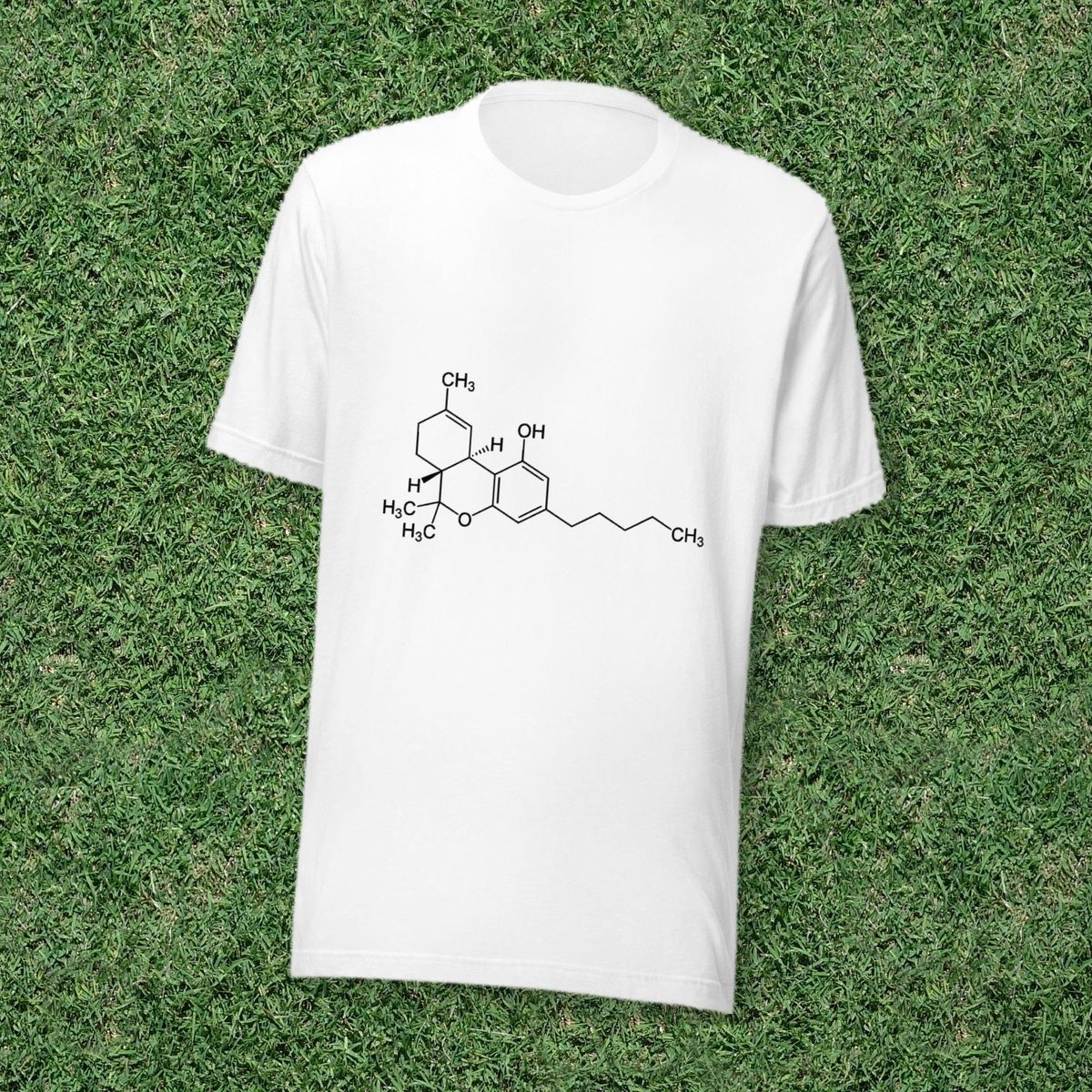
What is printed. Printed on the chest is the skeletal structure of delta-9-tetrahydrocannabinol, THC, C21H30O2, drawn as a line diagram with its name and formula beneath. The drawing shows a tricyclic dibenzopyran core: an aromatic ring carrying a phenol and a five-carbon pentyl chain, fused through a pyran ring bearing two methyl groups to a cyclohexene ring with a third methyl, and wedge bonds at the two stereocenters marking the natural (6aR,10aR) configuration. THC is the principal psychoactive constituent of the cannabis plant and the molecule whose study led to the discovery of the body's own cannabinoid system. The shirt is a chemistry drawing, nothing more.
History
Cannabis has been cultivated for fiber, seed and resin for at least 5,000 years, but its active compound stayed unknown long after morphine, cocaine and nicotine had been isolated, largely because it is an oil rather than a crystallizable base. In 1964 Yechiel Gaoni and Raphael Mechoulam at the Weizmann Institute of Science in Rehovot, Israel, working from Moroccan hashish supplied by the police, isolated delta-9-THC, determined its structure and reported it in the Journal of the American Chemical Society on 1 April 1964. The same group published a total synthesis in 1965. The question of how an oily plant compound acts on the brain was answered a generation later: a specific cannabinoid binding site was characterized in 1988, the CB1 receptor was cloned in 1990, and in 1992 Mechoulam's laboratory identified anandamide, the first endogenous cannabinoid. On the regulatory side, the United States placed cannabis and THC in Schedule I of the Controlled Substances Act in 1970; synthetic THC, dronabinol, was approved by the FDA in 1985 and moved to Schedule III in 1999. Uruguay legalized adult cannabis use nationally in 2013 and Canada in 2018. On 2 December 2020 the UN Commission on Narcotic Drugs voted 27 to 25 to remove cannabis from Schedule IV of the 1961 Single Convention, acknowledging medical value while keeping it under control.
What thc does
THC is a partial agonist at the cannabinoid receptors CB1 and CB2, G protein-coupled receptors that are among the most abundant in the brain, where CB1 sits on presynaptic terminals and dampens the release of other neurotransmitters. The body's own ligands for these receptors are anandamide and 2-AG. In nature THC barely exists in the living plant: Cannabis sativa makes tetrahydrocannabinolic acid (THCA) in its glandular trichomes, and heat or time removes a carboxyl group to give THC. Licensed medical uses are narrow and specific: synthetic THC (dronabinol) is approved in the United States for nausea from cancer chemotherapy and for appetite loss in AIDS, and nabiximols, a THC and CBD mouth spray, was approved in the United Kingdom in 2010 for muscle spasticity in multiple sclerosis. Legal status varies widely by country and, in the United States, by state.
Who wears it
Cannabis-industry staff, from cultivators and extraction chemists to dispensary teams in legal jurisdictions, wear it as the emblem of their trade drawn correctly. Pharmacology and neuroscience students buy it because the endocannabinoid system is a modern discovery story they can date: 1964, 1988, 1990, 1992. Analytical chemists who run potency testing like seeing the exact isomer they quantify. Patients and caregivers in medical cannabis programs choose it as a plain, factual design without leaf imagery. Organic chemists appreciate Mechoulam's work and the terpenophenolic skeleton. It appeals to anyone who wants the structure rather than the stereotype.
Facts
- Delta-9-THC was isolated and its structure determined by Yechiel Gaoni and Raphael Mechoulam at the Weizmann Institute in 1964.
- The CB1 cannabinoid receptor was cloned in 1990, and the first endocannabinoid, anandamide, was identified in 1992.
- The cannabis plant makes THCA; THC forms when the acid loses carbon dioxide on heating.
- Synthetic THC, dronabinol, was approved by the US FDA in 1985 and reclassified to Schedule III in 1999.
- On 2 December 2020 the UN Commission on Narcotic Drugs voted 27 to 25 to remove cannabis from Schedule IV of the 1961 Single Convention.
The same molecule as a print
- THC Molecule (print), on Etsy from $29.99.
Frequently asked questions
- Is the thc structure on the shirt chemically accurate?
- Yes. It is the standard skeletal formula as recorded in PubChem (CID 16078): (6aR,10aR)-6,6,9-trimethyl-3-pentyl-6a,7,8,10a-tetrahydrobenzo[c]chromen-1-ol, the natural (-)-trans isomer, with wedge and hash bonds at the two stereocenters and the double bond in the delta-9 position. Hydrogens on carbon are implied, as in a textbook drawing.
- What exactly is printed, and in which colors?
- The skeletal line structure of thc, with the name THC and its formula set in letter-spaced capitals beneath it. It is printed on the chest of a unisex tee, either in white ink on a black shirt or in black ink on a white shirt. The lines are crisp at reading distance and the diagram is sized to be legible without dominating the shirt.
- Is it legal to wear?
- Yes. The shirt carries a chemistry diagram, the same drawing you would find in a pharmacology textbook or on PubChem, and a name and formula. Wearing a picture of a molecule is legal everywhere. The shirt contains no substance and says nothing about use.
- Is this the same molecule as CBD or delta-8-THC?
- No. CBD (cannabidiol) has the same formula, C21H30O2, but its pyran ring is open, so it is a different compound with different pharmacology. Delta-8-THC is an isomer that differs only in the position of one double bond. The shirt shows delta-9-THC, the isomer the plant produces in quantity and the one Gaoni and Mechoulam isolated in 1964.
Related molecule t-shirts
- Psilocybin t-shirt C12H17N2O4P
- LSD t-shirt C20H25N3O
- MDMA t-shirt C11H15NO2
Sources
- Tetrahydrocannabinol, Wikipedia
- Dronabinol (THC), PubChem CID 16078
- Gaoni Y, Mechoulam R. Isolation, Structure, and Partial Synthesis of an Active Constituent of Hashish. J Am Chem Soc 1964;86:1646
- UN Geneva: CND reclassifies cannabis (2 December 2020)
Published 25 Oct 2026; prices are the live Etsy prices as of 25 Oct 2026. The structure diagram is a fact of chemistry; this page's text is © ThinkDotCo and may be quoted with a link.