
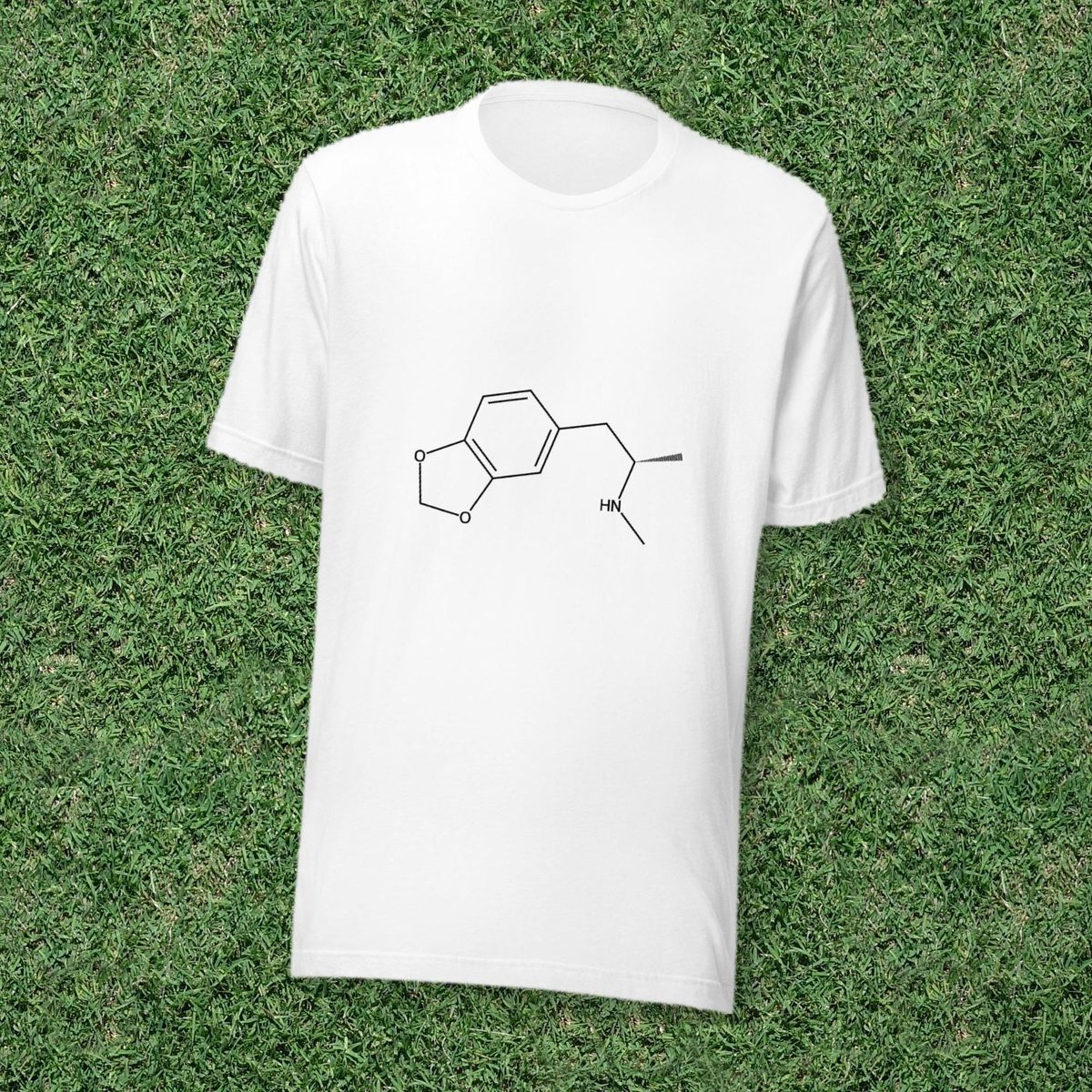
Molecule T-shirts · substituted amphetamine (entactogen)
MDMA T-Shirt
3,4-methylenedioxymethamphetamine: a synthetic phenethylamine first made at Merck in 1912 and never found in nature.
Printed to order on a Bella+Canvas 3001 unisex tee. Sizes, colours and the price per option are on the listing.
Printed to order, ships in 2–5 business daysReplaced free if it arrives damagedEtsy buyer protection
What is printed. Printed on the chest is the skeletal structure of MDMA, 3,4-methylenedioxymethamphetamine, C11H15NO2, drawn as a line diagram with its name and formula beneath. The drawing shows a benzene ring fused to a five-membered methylenedioxy ring, with a three-carbon side chain ending in a methylamine. The side chain carries one stereocenter; because the compound is made and studied as the racemate, the structure is drawn without a wedge, which is how PubChem and the pharmacology literature show it. MDMA is wholly synthetic, with no plant or animal source. The shirt is a diagram of a molecule with an unusual history, not a comment on using it.
History
MDMA was first made by Anton Kollisch, a chemist at Merck in Darmstadt, Germany, as an unnamed intermediate on the way to a blood-clotting agent, hydrastinine. Merck filed the patent on 24 December 1912 and it was issued on 16 May 1914; the document lists the compound only by its physical properties. Merck's records show a brief pharmacological look in 1927 under Max Oberlin, then nothing. The US Army Chemical Corps tested it in animals at Edgewood Arsenal in 1953 and 1954 under the code EA-1475, and results classified until 1973. The Californian chemist Alexander Shulgin synthesized it in 1976, and in 1978 he and David Nichols published the first scientific description of its effects in humans. Through the psychologist Leo Zeff it spread to a network of therapists in the late 1970s and early 1980s; Nichols coined the term entactogen for it in 1986. As recreational use grew, the US Drug Enforcement Administration placed it in Schedule I on an emergency basis on 1 July 1985 and permanently in 1988, and the UN added it to Schedule I of the 1971 Convention on Psychotropic Substances in 1986. Phase 3 trials of MDMA-assisted therapy for post-traumatic stress disorder were published in 2021 and 2023; Australia allowed authorized psychiatrists to prescribe it for PTSD from 1 July 2023, the US FDA declined approval in August 2024 and asked for more data, and a revised application was resubmitted in August 2026.
What mdma does
MDMA is a releasing agent for the monoamine neurotransmitters. It enters nerve terminals through the serotonin, norepinephrine and dopamine transporters, disrupts the vesicular transporter VMAT2, and reverses the direction of the membrane transporters so that the neurotransmitters flow out into the synapse; serotonin release is the largest effect and the one that most distinguishes it from amphetamine. Through serotonin 5-HT1A signaling it also raises circulating oxytocin, which is thought to underlie its prosocial character. The compound does not occur in nature; every sample is manufactured. It has no licensed medical use in the United States or Europe. Australia is the exception: since July 2023 psychiatrists authorized by the Therapeutic Goods Administration may prescribe it for PTSD within a therapy program. Elsewhere it is studied in clinical trials and otherwise a controlled substance.
Who wears it
Psychiatric researchers and trial coordinators working on PTSD studies wear it as the molecule at the center of their field's most watched regulatory story. Pharmacology students like it as the cleanest example of a monoamine releaser and of how one methylenedioxy ring changes a compound's character. Harm-reduction workers, drug-checking services and festival medical teams choose it as a neutral, factual design they can wear on shift. Therapists following the Australian rollout, historians of pharmacology interested in the Merck and Shulgin chapters, and electronic-music people who want the chemistry rather than a cliche all buy it. It is a structure, not a slogan.
Facts
- MDMA was first synthesized by Anton Kollisch at Merck in Darmstadt; the patent was filed on 24 December 1912 and issued on 16 May 1914.
- The US Army tested MDMA in animals at Edgewood Arsenal in 1953 and 1954 under the code EA-1475.
- Alexander Shulgin and David Nichols published the first description of MDMA's effects in humans in 1978; Nichols coined the word entactogen in 1986.
- The US DEA placed MDMA in Schedule I on an emergency basis on 1 July 1985.
- Since 1 July 2023 authorized psychiatrists in Australia may prescribe MDMA for PTSD, the first such approval anywhere.
The same molecule as a print
- MDMA Molecule (print), on Etsy from $29.99.
Frequently asked questions
- Is the mdma structure on the shirt chemically accurate?
- Yes. It is the standard skeletal formula as recorded in PubChem (CID 1615): 1-(1,3-benzodioxol-5-yl)-N-methylpropan-2-amine, a benzodioxole ring with a methylaminopropyl side chain. The one stereocenter on the side chain is drawn without a wedge because MDMA is made and studied as the racemic (RS) mixture, which is how the reference databases depict it. Hydrogens on carbon are implied.
- What exactly is printed, and in which colors?
- The skeletal line structure of mdma, with the name MDMA and its formula set in letter-spaced capitals beneath it. It is printed on the chest of a unisex tee, either in white ink on a black shirt or in black ink on a white shirt. The lines are crisp at reading distance and the diagram is sized to be legible without dominating the shirt.
- Is it legal to wear?
- Yes. The shirt carries a chemistry diagram, the same drawing you would find in a pharmacology textbook or on PubChem, and a name and formula. Wearing a picture of a molecule is legal everywhere. The shirt contains no substance and says nothing about use.
- How is MDMA related to amphetamine and methamphetamine?
- MDMA is methamphetamine with a methylenedioxy ring (an -O-CH2-O- bridge) added across the 3 and 4 positions of the benzene ring. That one change shifts the pharmacology from mainly dopamine and norepinephrine release toward serotonin release, which is why Nichols proposed the separate class name entactogen in 1986. Its ring-free relatives are not on the shirt; only MDMA is.
Related molecule t-shirts
- Serotonin t-shirt C10H12N2O
- Oxytocin t-shirt C43H66N12O12S2
- LSD t-shirt C20H25N3O
Sources
- MDMA, Wikipedia
- MDMA, PubChem CID 1615
- Anton Kollisch and the 1912 Merck patent, Wikipedia
- Therapeutic Goods Administration (Australia): change to classification of MDMA and psilocybin, 2023
Published 25 Oct 2026; prices are the live Etsy prices as of 25 Oct 2026. The structure diagram is a fact of chemistry; this page's text is © ThinkDotCo and may be quoted with a link.