
Molecule T-shirts · ergoline (semi-synthetic ergot alkaloid derivative)
LSD T-Shirt
A semi-synthetic ergot derivative made in Basel in 1938, active in millionths of a gram.
Printed to order on a Bella+Canvas 3001 unisex tee. Sizes, colours and the price per option are on the listing.
Printed to order, ships in 2–5 business daysReplaced free if it arrives damagedEtsy buyer protection
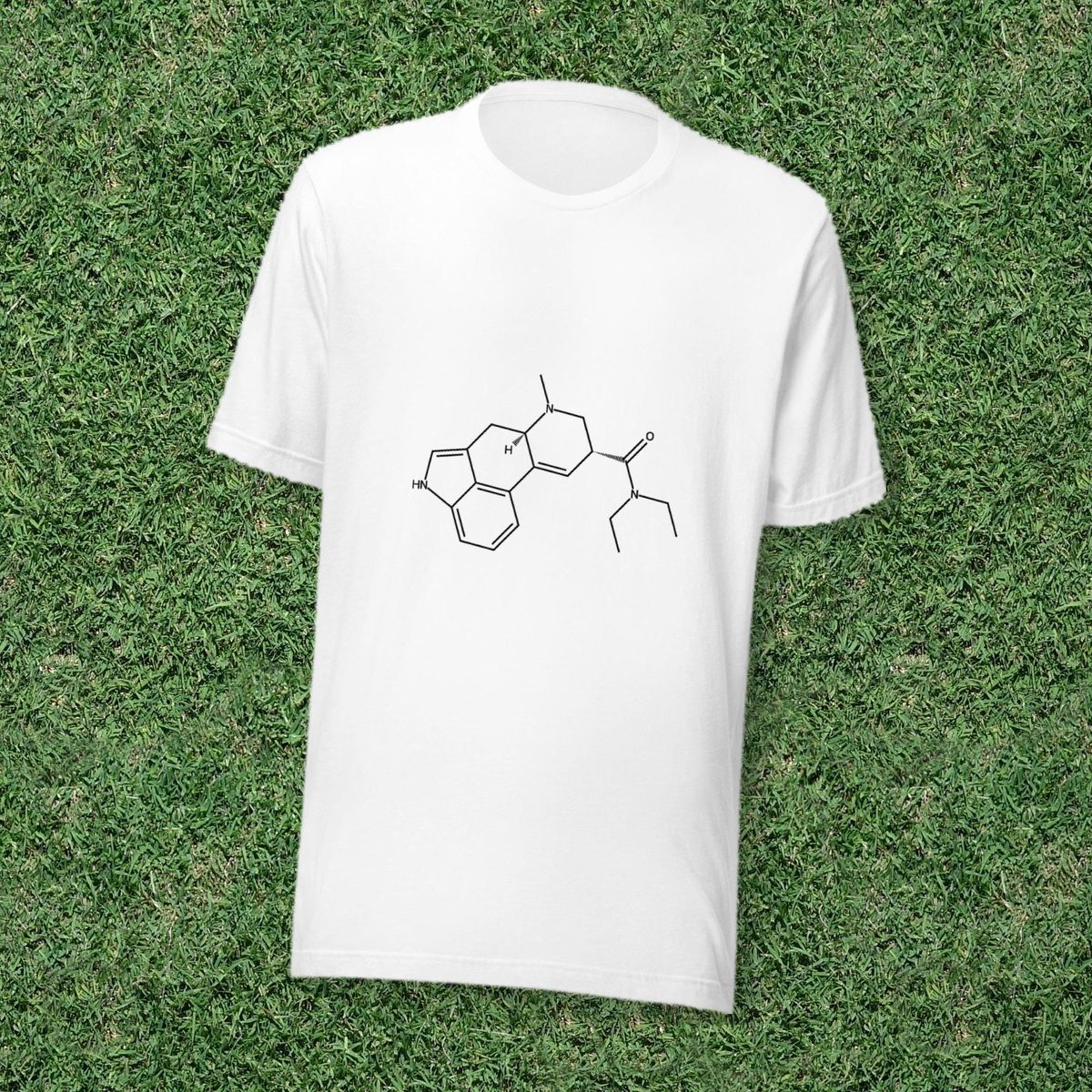
What is printed. This shirt carries the skeletal structure of lysergic acid diethylamide, LSD, drawn as a standard line diagram with the name and the formula C20H25N3O beneath it. The molecule belongs to the ergolines, a family built on a four-ring skeleton that nature assembles in the ergot fungus Claviceps purpurea, a parasite of rye. LSD itself does not occur in nature: Albert Hofmann made it in 1938 by attaching a diethylamide group to lysergic acid, the shared core of the ergot alkaloids. The drawing shows the indole ring fused to two further rings, an N-methyl group, a double bond in the fourth ring and the diethylamide arm, with wedge bonds marking the two stereocenters that make the active isomer.
History
Albert Hofmann synthesized LSD on November 16, 1938, in the Sandoz laboratories in Basel, Switzerland. He was working through amides of lysergic acid in search of a circulatory stimulant; this was the twenty-fifth, hence LSD-25. Animal tests showed nothing of interest and it was shelved. Hofmann returned to it on April 16, 1943, when accidental exposure during resynthesis produced a strange afternoon; on April 19 he took a measured amount deliberately, the self-experiment later nicknamed Bicycle Day for his ride home. Werner Stoll published the first psychiatric study in 1947, and that year Sandoz began supplying the compound to researchers under the name Delysid. Through the 1950s and early 1960s it was studied in psychiatry, by the CIA under MKUltra, and by hundreds of academic groups. Sandoz stopped distribution in 1966; the United States criminalized possession in 1968 and placed LSD in Schedule I of the Controlled Substances Act in 1970; the United Nations listed it in Schedule I of the Convention on Psychotropic Substances in 1971. Hofmann told the story in LSD: My Problem Child (1979) and died in 2008 at the age of 102. Clinical research resumed slowly; Peter Gasser's Swiss study of 2014 was the first in four decades. On March 7, 2024, the US Food and Drug Administration granted breakthrough therapy designation to MM120, a tartrate salt of LSD developed by MindMed for generalized anxiety disorder, and Phase 3 trials followed.
What lsd does
LSD is a partial agonist at serotonin 5-HT2A receptors, the mechanism shared by the classical psychedelics, and it also binds other serotonin receptors and dopamine D2 receptors. Its potency is exceptional: it is active in the human body at microgram quantities, which made it a tool for the early argument that chemistry underlies thought. The molecule does not exist in nature; its precursor lysergic acid is produced by the ergot fungus Claviceps purpurea and by some morning glory and Hawaiian baby woodrose seeds, which contain the related compound ergine. LSD is Schedule I in the United States and under the 1971 UN Convention. Research is active again: a Swiss trial in 2014, imaging studies at Imperial College London and the University of Zurich, and an FDA breakthrough therapy designation in 2024 for a pharmaceutical formulation in generalized anxiety disorder, now in Phase 3 trials. No LSD medicine is approved anywhere.
Who wears it
Chemists, first of all: the ergoline skeleton is a classic of natural products chemistry, and Hofmann's 1938 synthesis is taught as a case study in serendipity. Pharmacology and neuroscience students who know the 5-HT2A story. Readers of Hofmann's memoir, historians of the 1960s, and people who follow the current clinical trials. Cyclists who know what Bicycle Day commemorates. Designers and musicians who like the geometry of the four fused rings. The structure is recognizable to anyone who has seen it once, and the shirt works as a quiet nod rather than a slogan: it says Basel, 1938, and a chemist who lived to 102.
Facts
- LSD-25 was the twenty-fifth lysergic acid derivative in Hofmann's series; the first synthesis was on November 16, 1938.
- Hofmann's deliberate self-experiment on April 19, 1943, is commemorated as Bicycle Day after his ride home through Basel.
- Sandoz distributed LSD to researchers under the trade name Delysid from 1947 until 1966.
- Only one of the four possible stereoisomers, (+)-LSD with the 6aR,9R configuration, is strongly psychoactive.
- On March 7, 2024, the FDA granted breakthrough therapy designation to an LSD tartrate formulation for generalized anxiety disorder.
The same molecule as a print
Frequently asked questions
- Is the structure on the shirt chemically accurate?
- Yes. It is the standard skeletal formula of lysergic acid diethylamide as recorded in PubChem (CID 5761): the ergoline four-ring system with the indole at the bottom, the N-methyl group, the double bond in the D ring and the N,N-diethylamide group. The two stereocenters at positions 6a and 9 are shown with wedge bonds in the natural (6aR,9R) configuration.
- What exactly is printed, and in which colors?
- The skeletal structure of LSD, with the name and the molecular formula set beneath it in letter-spaced type. The design is printed as a single color on the chest of a unisex tee: white ink on a black shirt or black ink on a white shirt. The print area is the standard chest placement, about 10 to 12 inches wide depending on shirt size. The structure is drawn from PubChem compound data; the composition and typography are ThinkDotCo's own work.
- Is it legal to wear?
- Yes. The shirt carries a chemistry diagram, the same line drawing you would find in a textbook, an encyclopedia, or a government chemical database. A picture of a molecule is not the molecule. Wearing it is legal anywhere, including places where the compound itself is controlled. The shirt contains no substance of any kind and makes no claim about use.
- What does LSD stand for, and why 25?
- LSD is short for Lysergsaurediethylamid, the German for lysergic acid diethylamide; the English initials would be LAD. The 25 in LSD-25 was Hofmann's running number: it was the twenty-fifth lysergic acid amide he prepared at Sandoz in his search for a circulatory stimulant. Compounds 1 through 24 included methylergometrine, which did become a medicine for postpartum bleeding.
Related molecule t-shirts
- Psilocybin t-shirt C12H17N2O4P
- DMT t-shirt C12H16N2
- Serotonin t-shirt C10H12N2O
Sources
- Lysergic acid diethylamide, Wikipedia
- PubChem compound summary, CID 5761
- Hofmann A. LSD: My Problem Child (McGraw-Hill, 1980; German original 1979)
- Stoll W.A. Lysergsaure-diathylamid, ein Phantastikum aus der Mutterkorngruppe. Schweizer Archiv fur Neurologie und Psychiatrie 60, 279-323 (1947)
Published 25 Oct 2026; prices are the live Etsy prices as of 25 Oct 2026. The structure diagram is a fact of chemistry; this page's text is © ThinkDotCo and may be quoted with a link.