
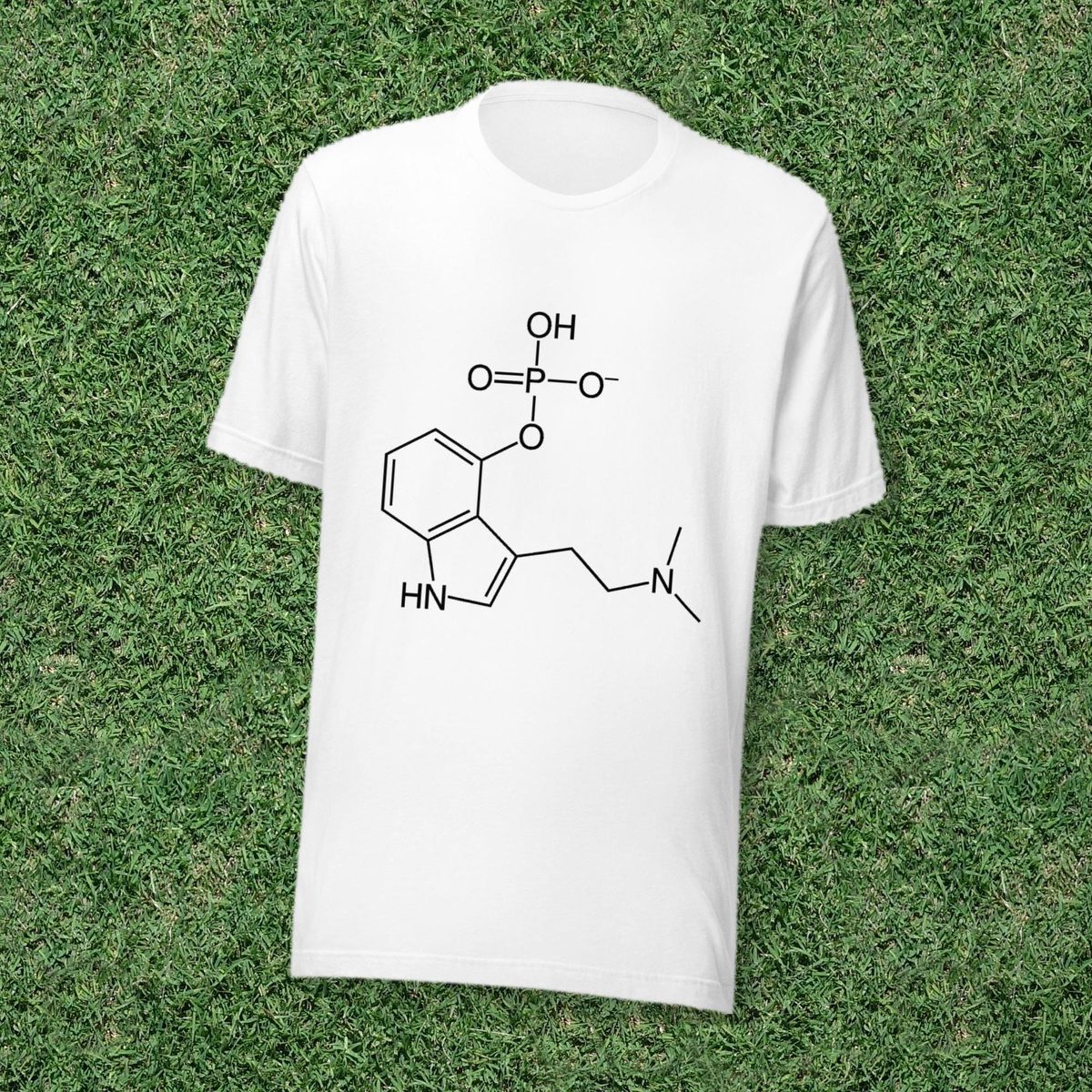
Molecule T-shirts · tryptamine alkaloid (phosphate prodrug)
Psilocybin T-Shirt
A phosphorylated tryptamine made by some 200 species of mushroom, isolated by Albert Hofmann in 1958.
Printed to order on a Bella+Canvas 3001 unisex tee. Sizes, colours and the price per option are on the listing.
Printed to order, ships in 2–5 business daysReplaced free if it arrives damagedEtsy buyer protection
What is printed. This shirt carries the skeletal structure of psilocybin drawn as a standard line diagram, with the name and the formula C12H17N2O4P beneath it. Psilocybin is a tryptamine alkaloid produced by mushrooms, mostly of the genus Psilocybe, and it is unusual among the molecules in this series for carrying a phosphate group: the ring bears an O-PO3H2 unit at the 4-position. In the body that phosphate is removed by enzymes to give psilocin, the compound that actually acts on the brain, so psilocybin is technically a prodrug. The drawing shows the indole ring with the dimethylaminoethyl side chain familiar from DMT and serotonin, plus the phosphate that makes the molecule water-soluble and stable in the dried mushroom.
History
Mushrooms containing psilocybin were used ceremonially in Mesoamerica long before European contact; the Aztecs called them teonanacatl, and the Franciscan friar Bernardino de Sahagun described their use in the sixteenth century. Modern science found them in 1955, when the American banker and amateur mycologist R. Gordon Wasson and the photographer Allan Richardson took part in a night ceremony led by the Mazatec healer Maria Sabina in Huautla de Jimenez, Oaxaca. Wasson's account, Seeking the Magic Mushroom, appeared in Life magazine on May 13, 1957. The French mycologist Roger Heim identified them as Psilocybe species, cultivated them in Paris and sent material to Albert Hofmann at Sandoz in Basel. In 1958 Hofmann's group isolated the two active compounds, named them psilocybin and psilocin, and determined their structures; the synthesis was published in 1959. Sandoz supplied psilocybin to researchers under the name Indocybin, and Harvard's psilocybin project of 1960 to 1962 made it famous and controversial. The United States placed psilocybin and psilocin in Schedule I in 1970, and the United Nations followed in 1971. Research restarted at Johns Hopkins, where Roland Griffiths published a double-blind study in 36 healthy volunteers in Psychopharmacology in 2006. The FDA granted breakthrough therapy designations to psilocybin programs in October 2018 (Compass Pathways, treatment-resistant depression) and November 2019 (Usona Institute, major depressive disorder). Oregon voters passed Measure 109 on November 3, 2020, creating the first state-licensed psilocybin services; Colorado passed Proposition 122 on November 8, 2022.
What psilocybin does
Psilocybin itself is largely inactive. Once in the body, phosphatase enzymes strip off the phosphate group to produce psilocin, a partial agonist at serotonin 5-HT2A receptors, the same target as LSD and DMT. The molecule occurs in roughly 200 mushroom species worldwide, concentrated in the genus Psilocybe but also found in Panaeolus, Gymnopilus and others; the blue bruising of these mushrooms is an oxidation product of psilocin. Psilocybin is Schedule I in the United States and under the 1971 UN Convention, though Oregon and Colorado license supervised services under state law and several countries permit the fresh mushrooms. Clinical research is extensive: trials in depression, end-of-life anxiety and alcohol use disorder have been published in major journals since 2016, two pharmaceutical programs hold FDA breakthrough therapy designation, and Phase 3 trials are under way. No psilocybin medicine is approved anywhere.
Who wears it
Mycologists and amateur mushroom hunters, who know Psilocybe as one genus among the hundreds they catalog. Neuroscience and pharmacology students who like the prodrug story and the serotonin resemblance. Clinicians and researchers in the growing trial network, and the patients and families following that work. Readers of Wasson's Life article and the Maria Sabina story, and anyone interested in Oaxaca and Mazatec culture. Chemistry teachers who want a wearable phosphate ester. Oregon and Colorado residents who voted in 2020 and 2022. The shirt reads as the chemistry of a mushroom, drawn as Hofmann would have drawn it in Basel in 1958.
Facts
- Albert Hofmann, who made LSD in 1938, also isolated psilocybin and psilocin from Psilocybe mexicana in 1958, twenty years later.
- Psilocybin is a prodrug: the body removes its phosphate group to produce psilocin, the active compound.
- R. Gordon Wasson's article Seeking the Magic Mushroom ran in Life magazine on May 13, 1957, and introduced the mushrooms to a mass audience.
- The blue stain on a bruised Psilocybe mushroom is an oxidation product of psilocin.
- Oregon Measure 109 passed on November 3, 2020, with 55.75 percent of the vote, creating the first state-regulated psilocybin program in the United States.
The same molecule as a print
- Psilocybin Molecule (print), on Etsy from $29.99.
Frequently asked questions
- Is the structure on the shirt chemically accurate?
- Yes. It is the standard skeletal formula of psilocybin as recorded in PubChem (CID 10624): the indole ring with the N,N-dimethylaminoethyl chain at the 3-position and the dihydrogen phosphate group at the 4-position. Psilocybin has no stereocenters, so no wedge bonds are needed. The phosphate is drawn in its neutral form, as in textbooks and the PubChem record.
- What exactly is printed, and in which colors?
- The skeletal structure of psilocybin, with the name and the molecular formula set beneath it in letter-spaced type. The design is printed as a single color on the chest of a unisex tee: white ink on a black shirt or black ink on a white shirt. The print area is the standard chest placement, about 10 to 12 inches wide depending on shirt size. The structure is drawn from PubChem compound data; the composition and typography are ThinkDotCo's own work.
- Is it legal to wear?
- Yes. The shirt carries a chemistry diagram, the same line drawing you would find in a textbook, an encyclopedia, or a government chemical database. A picture of a molecule is not the molecule. Wearing it is legal anywhere, including places where the compound itself is controlled. The shirt contains no substance of any kind and makes no claim about use.
- What is the difference between psilocybin and psilocin?
- One phosphate group. Psilocybin (C12H17N2O4P) carries a phosphate ester on the 4-position of the indole ring; psilocin (C12H16N2O) has a plain hydroxyl there. The phosphate makes psilocybin water-soluble and chemically stable, which is why dried mushrooms keep it, while psilocin oxidizes readily, which is what turns bruised mushrooms blue. Enzymes in the body convert one to the other, so psilocybin is described as a prodrug of psilocin.
Related molecule t-shirts
- DMT t-shirt C12H16N2
- Serotonin t-shirt C10H12N2O
- LSD t-shirt C20H25N3O
Sources
- Psilocybin, Wikipedia
- PubChem compound summary, CID 10624
- Hofmann A. et al. Psilocybin, ein psychotroper Wirkstoff aus dem mexikanischen Rauschpilz Psilocybe mexicana Heim. Experientia 14, 107-109 (1958)
- Griffiths R.R. et al. Psilocybin can occasion mystical-type experiences having substantial and sustained personal meaning and spiritual significance. Psychopharmacology 187, 268-283 (2006)
Published 25 Oct 2026; prices are the live Etsy prices as of 25 Oct 2026. The structure diagram is a fact of chemistry; this page's text is © ThinkDotCo and may be quoted with a link.