
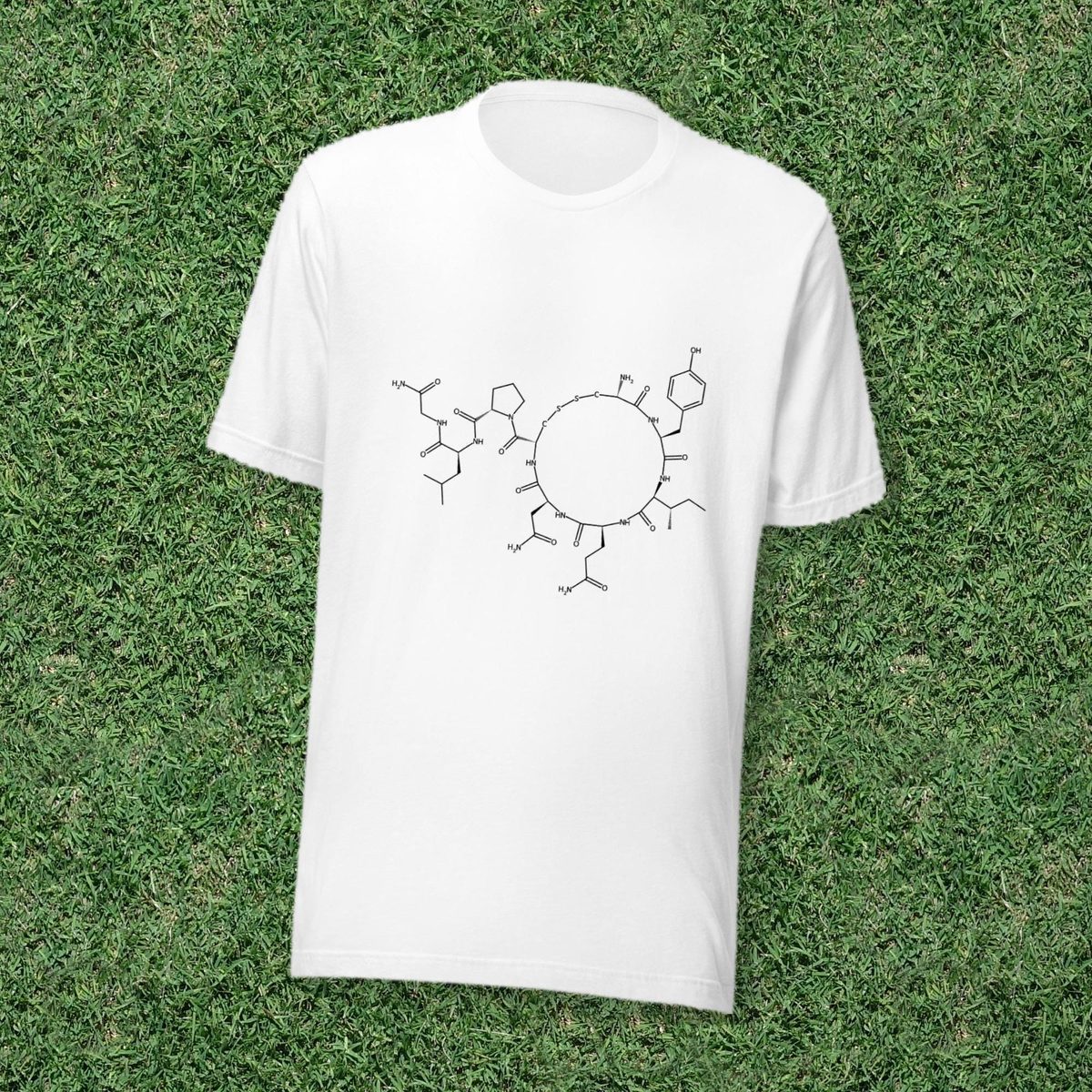
Molecule T-shirts · peptide hormone (cyclic nonapeptide)
Oxytocin T-Shirt
A nine-amino-acid hormone from the hypothalamus that drives labor, milk release and social bonding.
Printed to order on a Bella+Canvas 3001 unisex tee. Sizes, colours and the price per option are on the listing.
Printed to order, ships in 2–5 business daysReplaced free if it arrives damagedEtsy buyer protection
Printed to order on a Bella+Canvas 3001 unisex tee. Sizes, colours and the price per option are on the listing.
Printed to order, ships in 2–5 business daysReplaced free if it arrives damagedEtsy buyer protection
What is printed. Oxytocin is the largest molecule in the shop, and its shirt is the most intricate. The classic design prints the full skeletal formula of the peptide, nine amino acids joined in a chain with a sulfur-to-sulfur bridge closing six of them into a ring, together with the name and the formula C43H66N12O12S2. A second design arranges the same structure into the outline of a heart and prints it in color. Oxytocin is a hormone made in the hypothalamus and released from the posterior pituitary gland. It triggers the contractions of childbirth and the let-down of milk, and it is the molecule most often associated with trust, attachment and pair bonding in mammals.
Two designs
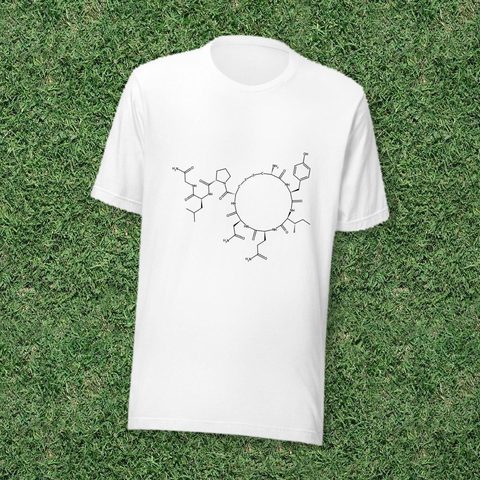
The nonapeptide drawn as a skeletal formula with full stereochemistry, one colour of ink.
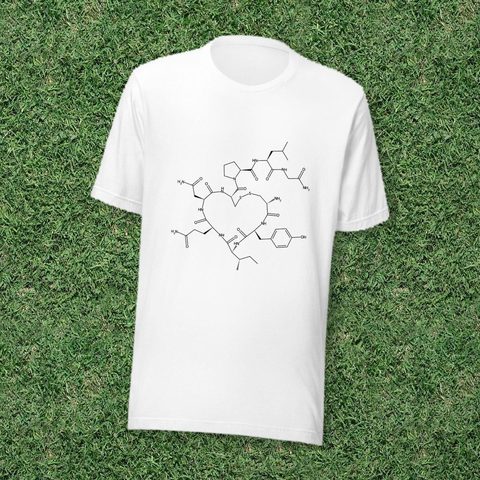
The same molecule with its macrocyclic ring drawn as a heart; the disulfide bridge forms the top. One-colour ink, or the red version.
History
In 1906 Henry Dale, working at the Wellcome Physiological Research Laboratories in London, found that an extract of the posterior pituitary gland made the uterus of a pregnant cat contract. He named the active principle oxytocin, from the Greek for swift birth. In 1910 Isaac Ott and John Scott showed that the same extract stimulated the flow of milk. Crude pituitary extract was used in obstetrics for decades, but it also contained a second hormone that raised blood pressure. In 1928 Oliver Kamm and his team at Parke-Davis in Detroit separated the two activities and established oxytocin and vasopressin as distinct substances. The decisive chemistry was done by Vincent du Vigneaud at Cornell University Medical College in New York. In 1953 his group determined that oxytocin is a nine-residue peptide, cysteine, tyrosine, isoleucine, glutamine, asparagine, cysteine, proline, leucine and glycinamide, with a disulfide bond linking the two cysteines, and in the same year they synthesized it, the first polypeptide hormone ever made in a laboratory. Du Vigneaud received the Nobel Prize in Chemistry in 1955. Synthetic oxytocin entered obstetric practice in the mid-1950s under trade names including Pitocin and Syntocinon, replacing the animal extracts. The human oxytocin receptor was cloned in 1992 by Tadashi Kimura and colleagues in Japan, opening the molecular study of how the hormone acts on the uterus, the breast and the brain.
What oxytocin does
Oxytocin acts on a single receptor, OXTR, a G protein-coupled receptor that raises intracellular calcium in the cells that carry it. The hormone is synthesized by neurons of the paraventricular and supraoptic nuclei of the hypothalamus and released from the posterior pituitary into the blood. In the uterus it drives the rhythmic contractions of labor; in the breast it contracts the cells around the milk ducts to release milk in response to suckling. Oxytocin released within the brain itself influences maternal behavior, pair bonding, social recognition and the stress response in many mammals, from prairie voles to humans, although the size of these effects in people is still debated. Synthetic oxytocin is used in hospitals to induce or strengthen labor and to control bleeding after delivery, and it is on the World Health Organization Model List of Essential Medicines. Every vertebrate studied so far carries oxytocin or a close relative of it.
Who wears it
Midwives, labor and delivery nurses, doulas and obstetricians make up the largest group of buyers; oxytocin is the molecule of their working day. Lactation consultants and new parents buy it in the first months after a birth, often as a gift from one partner to the other. Couples buy the heart-shaped color design for anniversaries and weddings, sometimes one shirt each. Neuroscientists and psychology students who study social behavior wear the classic structure. It is also a sensible choice for veterinary staff, who use oxytocin in animal obstetrics. Both designs read as affectionate without a single word of sentiment printed on them.
Facts
- Oxytocin is a cyclic nonapeptide: nine amino acids with a disulfide bridge between the cysteines at positions 1 and 6.
- Vincent du Vigneaud synthesized oxytocin in 1953, the first polypeptide hormone made in a laboratory, and received the Nobel Prize in Chemistry in 1955.
- Oxytocin and vasopressin differ in only two of their nine amino acids.
- The name oxytocin was coined by Henry Dale in 1906 from the Greek words for swift birth.
- Oxytocin is on the World Health Organization Model List of Essential Medicines for inducing labor and preventing postpartum bleeding.
The same molecule as a print
- Oxytocin Molecule (print: paper or framed), on Etsy from $29.99.
- Oxytocin Heart Molecule (print), on Etsy from $29.99.
- Oxytocin Heart Molecule Print in Red (print), on Etsy from $29.99.
Frequently asked questions
- Is the structure on the shirt chemically accurate?
- Yes. The classic design reproduces the standard skeletal formula of oxytocin, with all nine amino acid residues, the amide at the C-terminal glycine, and the disulfide bridge between the two cysteines. The stereocenters of the L-amino acids are shown with wedge and dash bonds where they occur. The heart-shaped design keeps the same atoms and bonds but bends the chain into a heart outline, so it is a stylized arrangement rather than a conventional textbook drawing.
- What exactly is printed, and in which colors?
- The classic design prints the skeletal structure, the name and the molecular formula on the chest in a single ink color: white ink on a black tee or black ink on a white tee. The heart-shaped design is a multicolor print on the chest, with the structure arranged as a heart. Neither design carries any other text or graphic.
- Why does the formula contain sulfur?
- The two sulfur atoms belong to the two cysteine residues. Their side chains are joined by a disulfide bond, which closes the first six amino acids into a ring and gives the hormone its working shape. Vasopressin, the body's water-retention hormone, has the same ring and differs from oxytocin at only two positions.
- Is the heart-shaped design scientifically accurate?
- It is chemically complete: every atom and bond of oxytocin is present and connected correctly. What changes is the layout. Skeletal formulas are two-dimensional conventions, and chemists already draw the same molecule in several orientations, so bending the chain into a heart adds and removes no chemistry. It would not pass as a journal figure, and it is not meant to.
Related molecule t-shirts
- Dopamine t-shirt C8H11NO2
- Serotonin t-shirt C10H12N2O
- MDMA t-shirt C11H15NO2
Sources
- Wikipedia: Oxytocin
- PubChem compound summary: Oxytocin (CID 439302)
- The Nobel Prize in Chemistry 1955: Vincent du Vigneaud, award ceremony speech
- Vincent du Vigneaud, Nobel Lecture 1955 (PDF)
Published 25 Oct 2026; prices are the live Etsy prices as of 25 Oct 2026. The structure diagram is a fact of chemistry; this page's text is © ThinkDotCo and may be quoted with a link.