
Molecule T-shirts · catecholamine neurotransmitter
Dopamine T-Shirt
The brain's reward and movement signal, a catecholamine made in the midbrain and the hypothalamus.
Printed to order on a Bella+Canvas 3001 unisex tee. Sizes, colours and the price per option are on the listing.
Printed to order, ships in 2–5 business daysReplaced free if it arrives damagedEtsy buyer protection
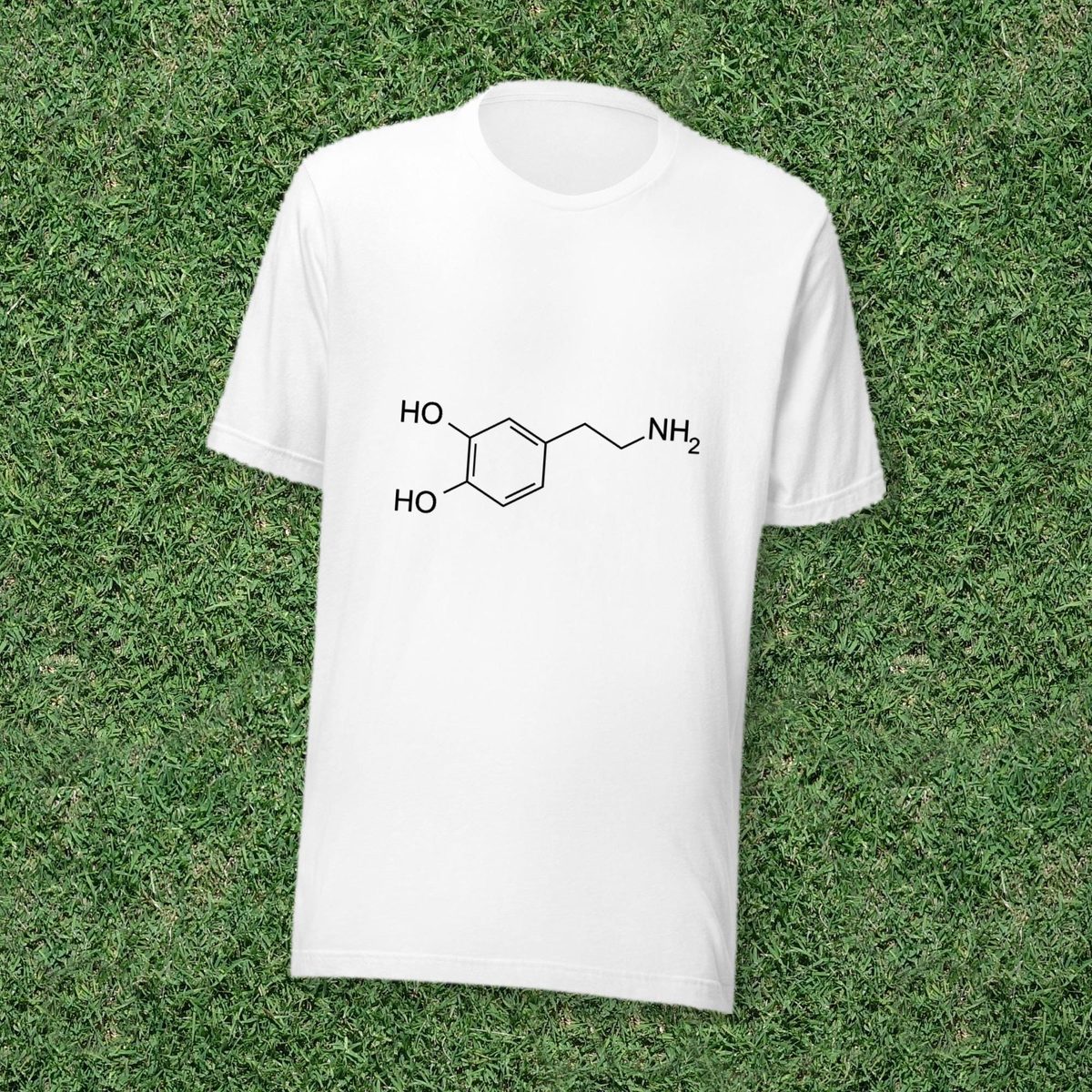
What is printed. The shirt shows the skeletal formula of dopamine, drawn as a line diagram with the name and the formula C8H11NO2. The structure is compact: a benzene ring carrying two hydroxyl groups side by side, the catechol, and a short two-carbon chain ending in an amine. Dopamine is a neurotransmitter, a chemical that nerve cells release to signal to their neighbors, and in the brain it is central to movement, motivation, learning from reward, and the regulation of the hormone prolactin. It is made by a surprisingly small number of neurons, a few hundred thousand in a human brain, whose fibers reach far across the striatum and the frontal cortex.
History
Dopamine was made in a laboratory decades before anyone knew the body made it. In 1910 George Barger and James Ewens synthesized 3,4-dihydroxyphenethylamine at the Wellcome Physiological Research Laboratories in London, and Henry Dale tested it the same year among a series of related amines, found it a weak pressor agent, and set it aside. It was Dale who, in 1952, proposed the name dopamine, a contraction of DOPA amine, because the molecule is the decarboxylation product of L-DOPA. For decades the compound was assumed to be nothing more than a way station on the route to noradrenaline. That changed in 1957. Kathleen Montagu, working in Hans Weil-Malherbe's laboratory at Runwell Hospital near London, reported dopamine in human brain tissue. The same year Arvid Carlsson and colleagues at Lund University in Sweden showed that rabbits immobilized by reserpine, which drains the brain of its amines, recovered when given L-DOPA, and that it was dopamine rather than noradrenaline whose return tracked the recovery. In 1960 Herbert Ehringer and Oleh Hornykiewicz in Vienna found dopamine reduced to about a tenth of normal in the striatum of patients who had died with Parkinson's disease. George Cotzias reported effective high-dose oral L-DOPA therapy in 1967. Carlsson shared the Nobel Prize in Physiology or Medicine in 2000.
What dopamine does
Dopamine acts on five G protein-coupled receptors, D1 through D5, grouped into D1-like receptors that raise cyclic AMP inside the cell and D2-like receptors that lower it. Most of the brain's dopamine comes from neurons in the substantia nigra and the ventral tegmental area of the midbrain. The nigrostriatal pathway supports the smooth initiation of movement; the mesolimbic and mesocortical pathways carry reward prediction signals, firing more when an outcome is better than expected and less when it is worse. In the hypothalamus, dopamine released into the pituitary blood supply inhibits prolactin secretion. Outside the brain it acts in the kidney and the gut and is the precursor of noradrenaline and adrenaline in the adrenal medulla. Dopamine does not cross the blood-brain barrier, which is why its precursor L-DOPA is the molecule given to patients with Parkinson's disease. It also occurs in plants, including bananas.
Who wears it
Neuroscience students and laboratory technicians are the core buyers. People living with Parkinson's disease, and the families and physiotherapists around them, wear it as a clear-eyed emblem of the molecule at the center of their lives. It is popular with people in recovery from addiction, who often know the reward circuitry better than most clinicians. Gamers, runners and anyone who has read a book about habits recognize it immediately. Psychiatric nurses and pharmacists buy it as a conversation piece for the ward. It also pairs naturally with the serotonin shirt for couples, roommates or lab partners who want matching molecules without matching shirts.
Facts
- Dopamine was first synthesized in 1910 by George Barger and James Ewens at the Wellcome laboratories in London.
- The name dopamine was proposed by Henry Dale in 1952, short for DOPA amine.
- Arvid Carlsson shared the 2000 Nobel Prize in Physiology or Medicine for showing that dopamine is a neurotransmitter in its own right.
- Dopamine cannot cross the blood-brain barrier; its precursor L-DOPA can, and is the standard medication for Parkinson's disease.
- Dopamine also occurs in plants, including the pulp and peel of bananas.
The same molecule as a print
- Dopamine Molecule (print: paper or framed), on Etsy from $29.99.
- Dopamine Molecule (print: gallery-wrapped canvas), on Etsy from $111.99.
Frequently asked questions
- Is the structure on the shirt chemically accurate?
- Yes. It is the standard skeletal formula of 3,4-dihydroxyphenethylamine: a benzene ring with hydroxyl groups on two adjacent carbons and a two-carbon chain ending in a primary amine. Dopamine has no stereocenters, so there are no wedge or dashed bonds; the flat drawing is the complete structure.
- What exactly is printed, and in which colors?
- The skeletal structure, the name and the molecular formula are printed on the chest in a single ink color: white ink on a black tee or black ink on a white tee. There is no other text or graphic on the shirt, so the drawing reads as the design.
- Is dopamine really the pleasure molecule?
- Not quite. Recordings from dopamine neurons since the 1990s show that they signal the difference between the reward an animal expected and the reward it got, which drives learning and motivation rather than pleasure itself. The shirt sticks to the chemistry; what you read into it is up to you.
- Is dopamine the same as L-DOPA?
- No. L-DOPA is dopamine with an extra carboxylic acid group; the enzyme DOPA decarboxylase removes it to make dopamine. L-DOPA is given as a medicine because it crosses the blood-brain barrier and dopamine does not. The shirt shows dopamine, the finished neurotransmitter.
Related molecule t-shirts
- Serotonin t-shirt C10H12N2O
- Adrenaline t-shirt C9H13NO3
- Cocaine t-shirt C17H21NO4
Sources
- Wikipedia: Dopamine
- PubChem compound summary: Dopamine (CID 681)
- Arvid Carlsson, and the story of dopamine (Indian J Psychiatry, 2009)
- The Nobel Prize in Physiology or Medicine 2000: Arvid Carlsson
Published 25 Oct 2026; prices are the live Etsy prices as of 25 Oct 2026. The structure diagram is a fact of chemistry; this page's text is © ThinkDotCo and may be quoted with a link.