
Molecule T-shirts · pyridine alkaloid
Nicotine T-Shirt
The alkaloid of the tobacco plant: two small rings, isolated in 1828 and named after a French ambassador.
Printed to order on a Bella+Canvas 3001 unisex tee. Sizes, colours and the price per option are on the listing.
Printed to order, ships in 2–5 business daysReplaced free if it arrives damagedEtsy buyer protection
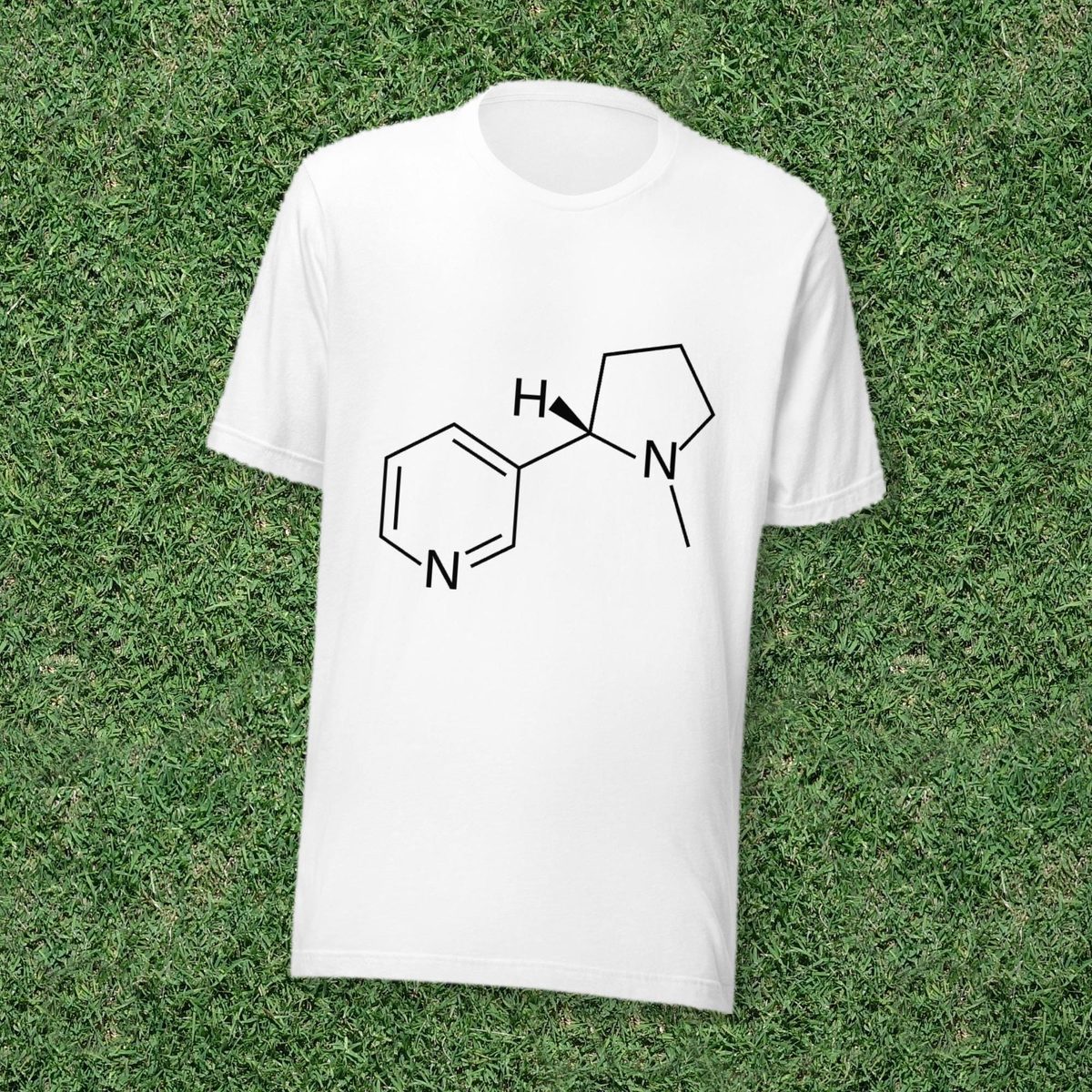
What is printed. Printed on the chest is the skeletal structure of nicotine, C10H14N2, drawn as a line diagram with its name and formula beneath. It is one of the smallest molecules in the series: a six-membered pyridine ring joined by a single bond to a five-membered N-methylpyrrolidine ring, with one stereocenter at the junction. The natural product is the (S) enantiomer, and the drawing shows it. Nicotine is the defining alkaloid of the tobacco plant, Nicotiana tabacum, and the compound after which an entire class of acetylcholine receptors is named. The shirt is a chemistry diagram; it says nothing about smoking.
History
Tobacco reached Europe in the sixteenth century, and the plant genus was named Nicotiana after Jean Nicot, the French ambassador to Portugal who sent seeds and leaves to the French court in 1560. The alkaloid itself was isolated in 1828 by Wilhelm Heinrich Posselt and Karl Ludwig Reimann, two students at the University of Heidelberg, who obtained a colorless, volatile oil from tobacco leaves and named it after the plant. The Belgian chemist Louis Melsens established its empirical formula, C10H14N2, in 1843. Adolf Pinner worked out the structure in Berlin in a series of papers between 1891 and 1895, settling it in 1893, and Ame Pictet and Arnold Rotschy achieved the first laboratory synthesis in Geneva in 1904. Nicotine then became a tool of pharmacology: John Newport Langley's 1905 experiments with nicotine and curare on muscle led him to propose a receptive substance on cells, an early statement of the receptor concept. Nicotine was widely used as an agricultural insecticide through the twentieth century; the European Union withdrew approval in 2009 and the US Environmental Protection Agency canceled the last registrations in 2014. Nicotine replacement products were added to the WHO Model List of Essential Medicines in 2009.
What nicotine does
Nicotine is an agonist at nicotinic acetylcholine receptors, ligand-gated ion channels found at the neuromuscular junction, in autonomic ganglia and throughout the brain; the receptor family takes its name from this molecule. In the brain, activation of alpha4beta2 receptors on dopamine neurons in the ventral tegmental area is the mechanism most studied. In nature nicotine is made in the roots of tobacco plants and transported to the leaves, where it functions as a defense against insects; dried tobacco leaf is typically 0.6 to 3 percent nicotine, and trace amounts occur in related nightshades including tomato, potato and eggplant. Licensed medical use is as nicotine replacement therapy for smoking cessation, in patches, gum, lozenges, inhalers and sprays, which the WHO lists as essential medicines. Nicotine itself is not a scheduled substance under the UN drug conventions.
Who wears it
Pharmacology students and neuroscientists wear it because the nicotinic receptor is one of the first receptors taught in any course, and this is the molecule it was named for. Smoking-cessation counselors and respiratory nurses buy it as a reminder of the compound they help people step away from. Former smokers choose it the way people choose any marker of a habit they ended. Botanists and entomologists like its origin as a plant insecticide, and organic chemists enjoy a structure small enough to draw from memory. It also suits anyone who likes the odd history: a molecule named after a diplomat, isolated by two students.
Facts
- Nicotine was isolated from tobacco leaves in 1828 by Posselt and Reimann at the University of Heidelberg.
- The plant genus Nicotiana, and so the molecule, is named after Jean Nicot, French ambassador to Portugal in 1560.
- Adolf Pinner established the structure in 1893; Ame Pictet and Arnold Rotschy first synthesized it in 1904.
- Nicotinic acetylcholine receptors, found throughout the nervous system, are named after nicotine.
- Nicotine gum and patches have been on the WHO Model List of Essential Medicines since 2009.
The same molecule as a print
- Nicotine Molecule (print), on Etsy from $29.99.
Frequently asked questions
- Is the nicotine structure on the shirt chemically accurate?
- Yes. It is the standard skeletal formula as recorded in PubChem (CID 89594): 3-[(2S)-1-methylpyrrolidin-2-yl]pyridine, a pyridine ring bonded to an N-methylpyrrolidine ring, with a wedge bond at the single stereocenter so that the natural (S)-(-)-nicotine enantiomer is shown. Hydrogens on carbon are implied.
- What exactly is printed, and in which colors?
- The skeletal line structure of nicotine, with the name NICOTINE and its formula set in letter-spaced capitals beneath it. It is printed on the chest of a unisex tee, either in white ink on a black shirt or in black ink on a white shirt. The lines are crisp at reading distance and the diagram is sized to be legible without dominating the shirt.
- Is it legal to wear?
- Yes. The shirt carries a chemistry diagram, the same drawing you would find in a pharmacology textbook or on PubChem, and a name and formula. Wearing a picture of a molecule is legal everywhere. The shirt contains no substance and says nothing about use.
- Is nicotine the same thing as tobacco or vape liquid?
- No. Nicotine is one pure compound, C10H14N2. Tobacco leaf contains thousands of compounds, and smoke adds thousands more from combustion; vape liquids contain nicotine dissolved in propylene glycol and glycerin with flavorings. The shirt shows only the alkaloid, which is also the active ingredient in licensed nicotine replacement patches and gum.
Related molecule t-shirts
- Caffeine t-shirt C8H10N4O2
- Dopamine t-shirt C8H11NO2
- Cocaine t-shirt C17H21NO4
Sources
- Nicotine, Wikipedia
- Nicotine, PubChem CID 89594
- WHO Essential Medicines List: nicotine replacement therapy (2009 recommendation)
- The History of Nicotine, University of Bristol Molecule of the Month
Published 25 Oct 2026; prices are the live Etsy prices as of 25 Oct 2026. The structure diagram is a fact of chemistry; this page's text is © ThinkDotCo and may be quoted with a link.