
Molecule T-shirts · methylxanthine alkaloid
Caffeine T-Shirt
The most widely used psychoactive compound on earth, a bitter alkaloid from coffee, tea and cacao.
Printed to order on a Bella+Canvas 3001 unisex tee. Sizes, colours and the price per option are on the listing.
Printed to order, ships in 2–5 business daysReplaced free if it arrives damagedEtsy buyer protection
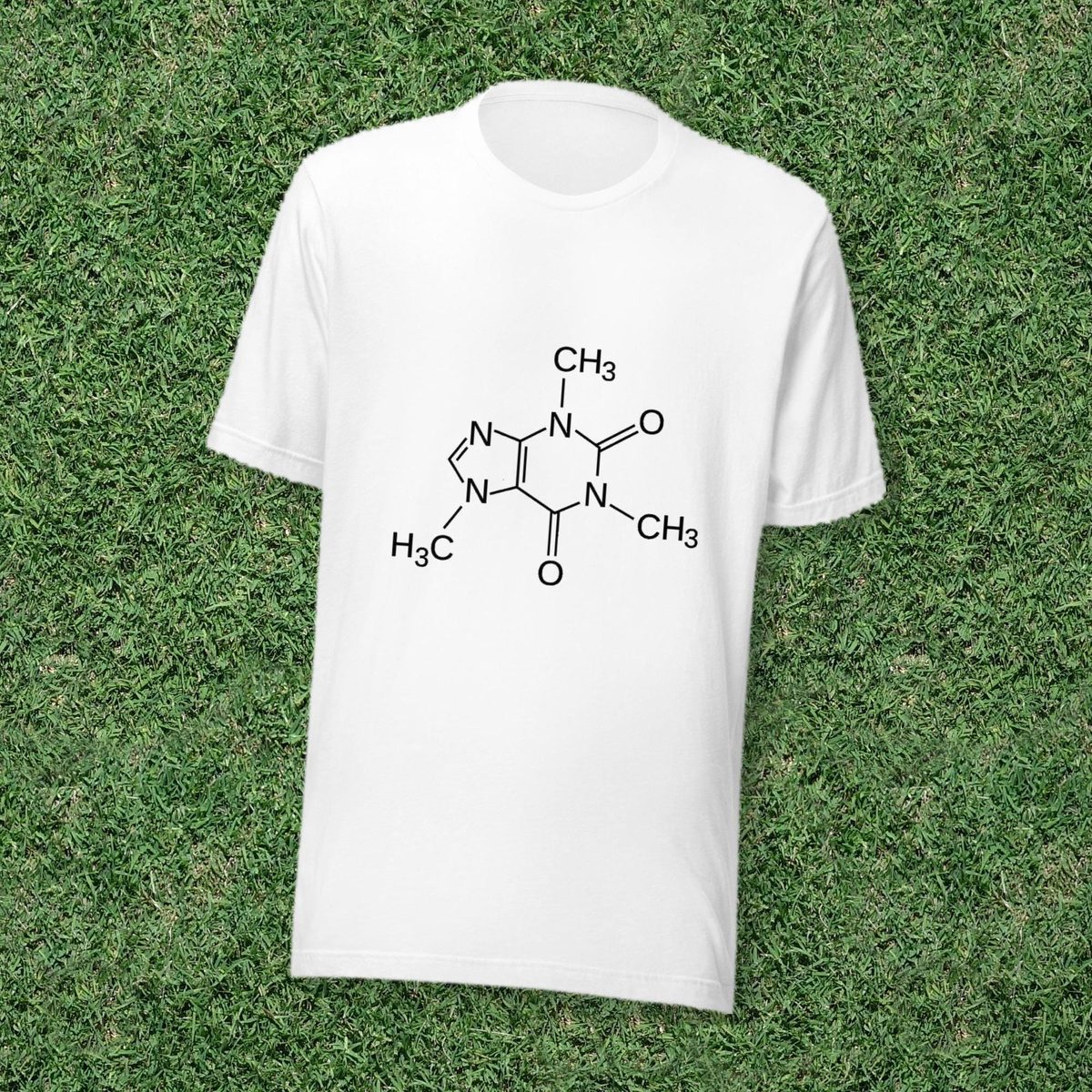
What is printed. Printed across the chest is the skeletal formula of caffeine, drawn as a line diagram with the name and the formula C8H10N4O2. The two fused rings, one six-membered and one five-membered, with their four nitrogen atoms and two carbonyl oxygens, form a purine core that is also the backbone of adenine and guanine in DNA. Caffeine is a bitter white alkaloid made by roughly sixty plant species, including coffee, tea, cacao, guarana, yerba mate and kola. For the plant it is a pesticide that paralyzes insects. For people it is the most widely consumed psychoactive substance in the world, and one of the few that is legal and largely unregulated almost everywhere.
History
Caffeine was isolated in 1819 by the German chemist Friedlieb Ferdinand Runge, then twenty-five, after the poet Johann Wolfgang von Goethe handed him a box of coffee beans and suggested he analyze them. Runge had just demonstrated to Goethe how belladonna extract dilates a cat's pupil. He called the white crystals Kaffebase. In 1821 three French chemists, Pierre Jean Robiquet, Pierre Joseph Pelletier and Joseph Bienaime Caventou, isolated the same substance independently; Pelletier gave it the name cafeine. Tea seemed to hold a different stimulant, which Oudry named theine in 1827, until Gerardus Mulder and Carl Jobst showed in 1838 that theine and caffeine were identical. Determining the structure took most of the century. Hermann Emil Fischer in Berlin proposed a structure in 1882, achieved the first total synthesis in 1895, and published corrected structural formulas in 1897 once he had worked out the chemistry of the whole purine family. That body of work on purines and sugars earned Fischer the Nobel Prize in Chemistry in 1902. Industrial decaffeination arrived in 1903, when the Bremen coffee merchant Ludwig Roselius developed a process that steamed green beans and extracted the caffeine with benzene, a solvent long since replaced by safer methods.
What caffeine does
Caffeine works mainly by blocking adenosine receptors, especially the A1 and A2A subtypes, in the brain and elsewhere. Adenosine accumulates during waking hours and promotes drowsiness; because caffeine has a similar shape, it occupies the receptor without activating it, and the sleep signal is muted. Downstream, this raises the activity of dopamine and noradrenaline neurons. Caffeine is absorbed from the gut within about forty-five minutes and broken down in the liver by the enzyme CYP1A2 into paraxanthine, theobromine and theophylline, each with mild activity of its own. The average elimination half-life in healthy adults is around five hours, though genetics, pregnancy, smoking and some medicines shift it widely. In plants it deters herbivores and inhibits germination of competing seeds nearby. Caffeine citrate is a licensed medicine for apnea of prematurity in newborns.
Who wears it
Baristas and roasters are the obvious buyers, and the shirt works as a uniform for a small cafe team. Night-shift nurses, medical residents and software engineers wear it as a self-aware joke about what keeps them upright. Chemistry teachers like that the purine rings connect caffeine to the bases of DNA, a point they can make from the front of the room. Graduate students buy it for defense day. It is also a reliable gift for a parent or partner who cannot form sentences before the first cup. Among the molecule shirts in the shop, caffeine is the one that needs no explanation at all.
Facts
- Caffeine is a purine alkaloid; its two-ring core is the same scaffold found in adenine and guanine.
- Roughly sixty plant species produce caffeine, including coffee, tea, cacao, kola, guarana and yerba mate.
- Caffeine was isolated in 1819 by Friedlieb Ferdinand Runge, working with coffee beans given to him by Goethe.
- Emil Fischer completed the first synthesis of caffeine in 1895 and received the Nobel Prize in Chemistry in 1902.
- The three main metabolites of caffeine in the human liver are paraxanthine, theobromine and theophylline.
The same molecule as a print
- Caffeine Molecule (print: paper or framed), on Etsy from $54.99.
Frequently asked questions
- Is the structure on the shirt chemically accurate?
- Yes. It is the standard skeletal formula of 1,3,7-trimethylxanthine: a six-membered pyrimidinedione ring fused to a five-membered imidazole ring, with three methyl groups on nitrogen atoms and two carbonyl oxygens. Caffeine has no stereocenters, so there are no wedge or dashed bonds; the drawing is the flat structure every chemistry textbook uses.
- What exactly is printed, and in which colors?
- The skeletal structure, the name and the molecular formula are printed on the chest in a single ink color: white ink on a black tee or black ink on a white tee. There is no other text or graphic on the shirt, so the drawing reads as the design.
- Is caffeine the same molecule as the one in chocolate?
- Nearly. The main stimulant in cacao is theobromine, which has two methyl groups where caffeine has three; remove the methyl on caffeine's N1 nitrogen and you have theobromine. Theophylline, long used in asthma treatment, is another dimethyl cousin. All three belong to the methylxanthine family, and the body converts some caffeine into both of the others.
- Does decaf coffee still contain caffeine?
- A little. Decaffeination removes about 97 percent or more of the caffeine from the green beans, so a cup of decaf typically holds a few milligrams, compared with roughly 80 to 100 milligrams in a regular eight-ounce brewed cup. The amount in any cup depends on bean, roast, grind and brew time.
Related molecule t-shirts
- Nicotine t-shirt C10H14N2
- Dopamine t-shirt C8H11NO2
- Adrenaline t-shirt C9H13NO3
Sources
- Wikipedia: Caffeine
- PubChem compound summary: Caffeine (CID 2519)
- Wikipedia: Friedlieb Ferdinand Runge
- The Nobel Prize in Chemistry 1902: Emil Fischer, facts
Published 25 Oct 2026; prices are the live Etsy prices as of 25 Oct 2026. The structure diagram is a fact of chemistry; this page's text is © ThinkDotCo and may be quoted with a link.