
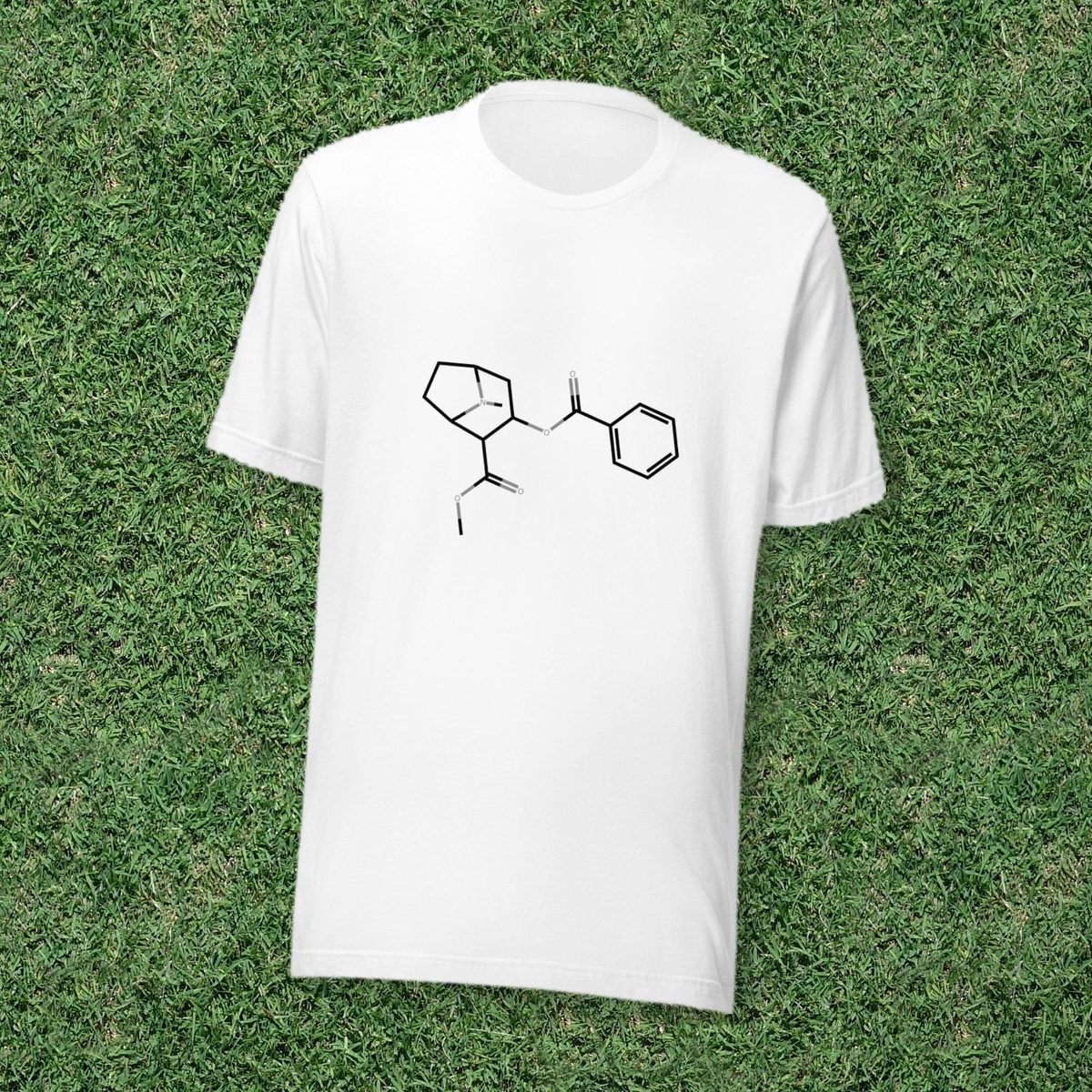
Molecule T-shirts · tropane alkaloid
Cocaine T-Shirt
The tropane alkaloid of the coca leaf, isolated in 1860 and the first local anesthetic used in surgery.
Printed to order on a Bella+Canvas 3001 unisex tee. Sizes, colours and the price per option are on the listing.
Printed to order, ships in 2–5 business daysReplaced free if it arrives damagedEtsy buyer protection
What is printed. Printed on the chest is the skeletal structure of cocaine, methyl benzoylecgonine, C17H21NO4, drawn as a line diagram with its name and formula beneath. The drawing shows a bicyclic tropane ring bridged by a methylated nitrogen, a methyl ester on one carbon and a benzoyl ester on the next, with wedge bonds marking the four stereocenters. Cocaine is the principal alkaloid of the coca shrub, Erythroxylum coca, native to the Andes. It is the parent compound of the ester local anesthetics and the reason chemists first understood how a drug could numb a nerve. The shirt is a piece of chemistry, not a statement about the substance.
History
Coca leaves have been chewed in the Andes for thousands of years; archaeological finds in northern Peru put the practice back at least 8,000 years. European chemists went looking for the active compound in the 1850s. In 1860 Albert Niemann, a doctoral student at the University of Gottingen, obtained a pure crystalline base from coca leaves and named it cocaine, noting the numbness it produced on the tongue. In 1884 the Viennese ophthalmologist Karl Koller demonstrated that a solution of cocaine anesthetized the surface of the eye, making it the first local anesthetic used in surgery; the same year Sigmund Freud published his essay Uber Coca. Richard Willstatter established the structure and completed a synthesis in 1898, and the tropane ring he described became the template for a family of alkaloids including atropine. The compound found its way into tonics and patent medicines, and the backlash was swift: the United States restricted it under the Harrison Narcotics Tax Act of 1914, and the 1961 UN Single Convention placed it in Schedule I internationally. Cocaine remains a controlled substance everywhere, while a licensed topical formulation is still used in ear, nose and throat surgery.
What cocaine does
Cocaine blocks the transporters that recycle dopamine, norepinephrine and serotonin from the synapse, so those neurotransmitters linger and signal longer. It also blocks voltage-gated sodium channels in nerve fibers, which is the basis of its local anesthetic action and the reason nerve impulses stop at the site of application. In nature it occurs in the leaves of Erythroxylum coca and Erythroxylum novogranatense, where it makes up roughly 0.5 to 1 percent of dry leaf weight. The only licensed medical use today is as a topical anesthetic and vasoconstrictor for procedures on the nose and throat; the US FDA approved a cocaine hydrochloride nasal solution for that purpose in 2017. Synthetic descendants such as procaine and lidocaine replaced it for nearly everything else.
Who wears it
Pharmacology and medicinal chemistry students buy it because the tropane bicycle is one of the first alkaloid skeletons they learn to draw. Anesthetists and ENT surgeons wear it as a nod to Koller and the origin of their specialty. Organic chemists like it for Willstatter, whose structural work on this molecule helped earn his 1915 Nobel Prize. Harm-reduction workers and addiction counselors wear it as a conversation starter about the chemistry behind the headlines, and some people in recovery choose it as a marker of a substance they have left behind. It is also a straightforward chemistry-nerd shirt for anyone who prefers facts to logos.
Facts
- Cocaine was isolated from coca leaves in 1860 by Albert Niemann at the University of Gottingen.
- Karl Koller introduced cocaine as the first surgical local anesthetic in 1884, numbing the surface of the eye.
- Richard Willstatter determined the structure of cocaine and synthesized it in 1898.
- The molecule has four stereocenters; the natural product is the (1R,2R,3S,5S) isomer.
- A cocaine hydrochloride nasal solution remains FDA-approved as a topical anesthetic for nasal procedures.
The same molecule as a print
Frequently asked questions
- Is the cocaine structure on the shirt chemically accurate?
- Yes. It is the standard skeletal formula as recorded in PubChem (CID 446220): the 8-azabicyclo[3.2.1]octane tropane core with its N-methyl group, the methyl ester at C2 and the benzoyloxy group at C3, drawn with wedge and hash bonds at the four stereocenters so that the natural (1R,2R,3S,5S) isomer is shown. Hydrogens on carbon are implied, as in any textbook drawing.
- What exactly is printed, and in which colors?
- The skeletal line structure of cocaine, with the name COCAINE and its formula set in letter-spaced capitals beneath it. It is printed on the chest of a unisex tee, either in white ink on a black shirt or in black ink on a white shirt. The lines are crisp at reading distance and the diagram is sized to be legible without dominating the shirt.
- Is it legal to wear?
- Yes. The shirt carries a chemistry diagram, the same drawing you would find in a pharmacology textbook or on PubChem, and a name and formula. Wearing a picture of a molecule is legal everywhere. The shirt contains no substance and says nothing about use.
- What is the difference between cocaine and the other tropane alkaloids?
- Cocaine, atropine and scopolamine all share the bicyclic tropane ring, but their side groups and biology differ. Atropine and scopolamine from nightshade carry a tropic acid ester and act on muscarinic acetylcholine receptors. Cocaine carries a benzoyl ester and a methyl ester and acts on monoamine transporters and sodium channels. The shared ring is why Willstatter's 1898 work on cocaine mattered for the whole family.
Related molecule t-shirts
- Dopamine t-shirt C8H11NO2
- Nicotine t-shirt C10H14N2
- Caffeine t-shirt C8H10N4O2
Sources
- Cocaine, Wikipedia
- Cocaine, PubChem CID 446220
- Karl Koller and the first use of cocaine as a local anesthetic (1884), Wikipedia
- Albert Niemann, Wikipedia
Published 25 Oct 2026; prices are the live Etsy prices as of 25 Oct 2026. The structure diagram is a fact of chemistry; this page's text is © ThinkDotCo and may be quoted with a link.