
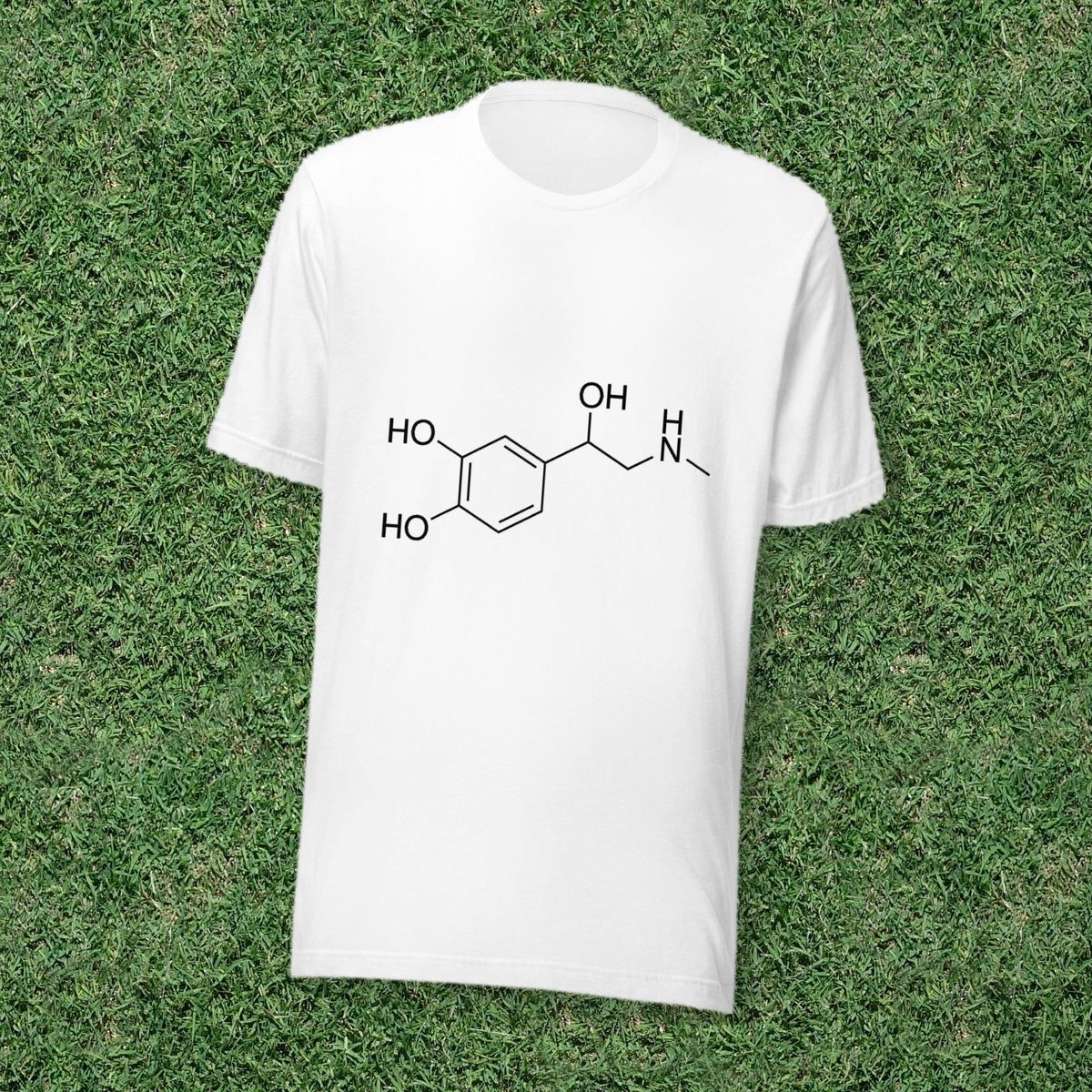
Molecule T-shirts · catecholamine hormone and neurotransmitter
Adrenaline T-Shirt
The fight-or-flight hormone from the adrenal glands, and the drug given for anaphylaxis.
Printed to order on a Bella+Canvas 3001 unisex tee. Sizes, colours and the price per option are on the listing.
Printed to order, ships in 2–5 business daysReplaced free if it arrives damagedEtsy buyer protection
What is printed. The shirt carries the skeletal formula of adrenaline, also called epinephrine, drawn as a clean line diagram with the name and the formula C9H13NO3 beneath it. Chemists read these line drawings the way musicians read a score: each corner is a carbon atom, hydrogens are left implied, and the benzene ring with its two hydroxyl groups marks the molecule as a catecholamine. Adrenaline is a hormone and neurotransmitter made in the core of the adrenal glands. It is released into the blood within seconds of fright, exertion or injury, and it is the same molecule a pharmacist dispenses in an auto-injector for severe allergic reactions.
History
Adrenaline was the first hormone ever isolated, and the race to get it was international. In 1894 the physician George Oliver and the physiologist Edward Schafer at University College London showed that an extract of the adrenal medulla sharply raised blood pressure in animals. In 1897 John Jacob Abel at Johns Hopkins University prepared a crystalline product from sheep adrenal glands that reproduced the effect; he named it epinephrine in 1899, though his material was later shown to be a derivative rather than the pure base. In 1901 the Japanese chemist Jokichi Takamine, working in New York with his assistant Keizo Uenaka, announced that he had isolated the active principle in pure, stable, crystalline form. He called it Adrenalin, patented the process, and licensed it to Parke-Davis, which sold it under that trade name. The first laboratory synthesis followed in 1904, by Friedrich Stolz at the Hoechst dye works in Germany. In 1908 Fritz Flaecher separated the two mirror-image forms and showed that the naturally occurring one is far more potent. The split in naming survives to this day: adrenaline in Britain and most of the world, epinephrine in the United States, where the Adrenalin trademark kept the shorter word out of the official pharmacopoeia.
What adrenaline does
Adrenaline acts on alpha and beta adrenergic receptors, a family of G protein-coupled receptors found on the heart, blood vessels, airways, liver and fat tissue. It is synthesized from the amino acid tyrosine by way of dopamine and noradrenaline, and the chromaffin cells of the adrenal medulla release it into the bloodstream under the control of the sympathetic nervous system. Once in circulation it raises heart rate and the force of each beat, dilates the airways, redirects blood toward skeletal muscle, and signals the liver to release glucose. A small amount also serves as a neurotransmitter in the brainstem. Epinephrine is the drug of first choice for anaphylaxis and appears on the World Health Organization Model List of Essential Medicines; it is also used in cardiac arrest and is added to local anesthetics to slow their spread.
Who wears it
Emergency physicians, paramedics and critical care nurses buy this shirt because epinephrine is the drug they reach for when seconds count. Endurance athletes, climbers and skydivers wear it as a quiet nod to the chemistry behind the rush they chase. Parents of children with severe food allergies have bought it as a conversation starter about carrying an auto-injector. Pharmacology and biochemistry students like that the structure doubles as a study aid for the whole catecholamine family: cover the methyl group on the nitrogen and you are looking at noradrenaline. It is a gift that works for anyone whose job or hobby runs on adrenaline in the literal sense.
Facts
- Adrenaline was the first hormone to be isolated in pure crystalline form, announced by Jokichi Takamine in 1901.
- The adrenal medulla makes adrenaline from the amino acid tyrosine in four enzymatic steps, by way of L-DOPA, dopamine and noradrenaline.
- Only the R enantiomer occurs in nature and carries nearly all of the biological activity; the two mirror-image forms were first separated in 1908.
- Epinephrine is on the World Health Organization Model List of Essential Medicines.
- Adrenaline comes from the Latin ad renes, near the kidneys; epinephrine says the same thing in Greek, epi nephros.
The same molecule as a print
- Adrenaline Molecule (print), on Etsy from $29.99.
Frequently asked questions
- Is the structure on the shirt chemically accurate?
- Yes. The design reproduces the standard skeletal formula of (R)-adrenaline: a benzene ring carrying hydroxyl groups at positions 3 and 4, a two-carbon side chain with a hydroxyl group on the carbon next to the ring, and a methylamino group at the end. The single stereocenter is drawn with a wedge bond to show the natural R configuration, which is the form your adrenal glands produce.
- What exactly is printed, and in which colors?
- The skeletal structure, the name and the molecular formula are printed on the chest in a single ink color: white ink on a black tee or black ink on a white tee. There is no other text or graphic on the shirt, so the drawing reads as the design.
- Is adrenaline the same thing as epinephrine?
- Yes. They are two names for one molecule. Adrenaline comes from Latin and is the everyday name in Britain, Europe and most of the world; epinephrine comes from Greek and is the official drug name in the United States, in part because Parke-Davis registered Adrenalin as a trademark in 1901. The shirt uses the name adrenaline.
- How does adrenaline differ from the dopamine shirt?
- Both are catecholamines built on the same benzene ring with two neighboring hydroxyl groups. Dopamine has a bare two-carbon chain ending in an amine. Noradrenaline adds a hydroxyl group to that chain. Adrenaline adds one more methyl group to the nitrogen. The body makes them in exactly that order, so the two shirts together show the start and the end of the pathway.
Related molecule t-shirts
- Dopamine t-shirt C8H11NO2
- Caffeine t-shirt C8H10N4O2
- Serotonin t-shirt C10H12N2O
Sources
- Wikipedia: Adrenaline
- PubChem compound summary: Epinephrine (CID 5816)
- Aronson JK. Where name and image meet: the argument for adrenaline. BMJ 2000;320:506
- Life in the Fast Lane: Adrenaline or epinephrine? (history of the discovery)
Published 25 Oct 2026; prices are the live Etsy prices as of 25 Oct 2026. The structure diagram is a fact of chemistry; this page's text is © ThinkDotCo and may be quoted with a link.